Ask five people what ChatGPT Ads cost and you'll get five different numbers, and all five will be defending a real, dated data point. Seven months after launch, OpenAI says the ad business it turned on is now running at a $1 billion annualized rate (a run rate, not booked revenue, by OpenAI's own framing), and there is still no single reliable "average CPC." That's the actual state of this market: a fast-moving auction, not a stable price. It has cleared at $1.72 a click for one advertiser and roughly $13 for another, in the same channel, within the same few months. Anyone selling you one "average CPC" is rounding off the part that matters.
Below: every price point OpenAI has published or been caught charging, in order, with receipts. Read the sequence and the calculator wars explain themselves. Everyone is quoting a different week of a price that has not sat still since February.
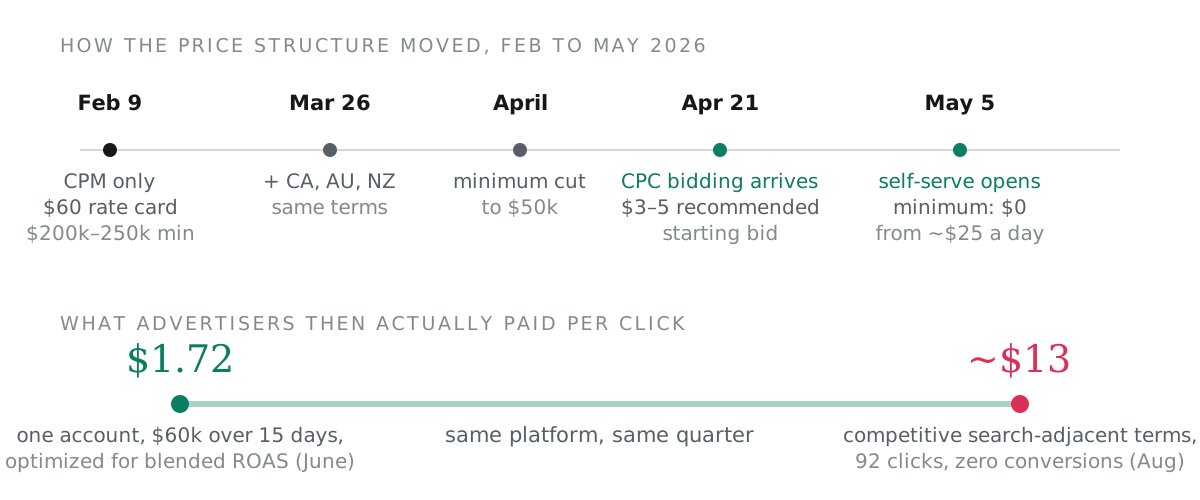
Feb 9, 2026: $60 CPM and a $200,000 floor
OpenAI opened ads inside ChatGPT to US logged-in adults on the Free and Go tiers on February 9, 2026. There was no bidding. Pricing ran on a flat cost-per-thousand-impressions basis, with a rate card around $60 CPM, and getting in required a commitment of $200,000 to $250,000, sold through OpenAI's ad-sales team and agency partners rather than through any self-serve tool (eMarketer, April 2026).
That structure (CPM-only, a six-figure floor, sold through people rather than a signup form) made the first ChatGPT ads an enterprise product; a small or mid-size advertiser could not buy in at any price. Ads render as a labeled "Sponsored" card below the answer, never inside it, and OpenAI's policy is that paid placement never changes the organic answer itself: the mechanical baseline everything below runs on. More on that machinery in how ChatGPT Ads actually work.
The floor falls twice in six weeks
On March 26, 2026, the pilot expanded to Canada, Australia, and New Zealand, still on the same CPM-only, sales-assisted terms.
Then the price structure started moving fast. By April 2026, OpenAI cut the minimum commitment from $200,000–$250,000 down to $50,000 (eMarketer, April 2026). Three weeks later, on April 21, 2026, OpenAI turned on cost-per-click bidding for the first time, with a recommended starting max bid of $3 to $5 per click, confirmed by screenshots of the ad console shared with Digiday (OpenAI didn't comment for that story) and later written into OpenAI's own help documentation.
Get the sequence right; it compresses into the wrong shape easily. ChatGPT Ads did not launch cheap and then get more expensive: they launched with no per-click price at all, CPM only, enterprise minimums. And $3 to $5 is what OpenAI recommended as a starting bid once click pricing existed. Everything below is what happened once real advertisers bid against that recommendation instead of just following it.
May 5, 2026: self-serve, and the minimum goes to zero
On May 5, 2026, OpenAI opened a self-serve ads console to every US business at ads.openai.com. The formal minimum spend disappeared entirely. Campaigns could now run from roughly $25 a day: a six-figure enterprise product twelve weeks earlier, an anyone-with-a-card product now (Axios, May 2026).
This is the date that matters most for a small or mid-size advertiser, more than the launch date itself. Everything published about ChatGPT Ads pricing since May 5 reflects a genuinely open auction rather than a hand-negotiated enterprise rate, which is exactly why the published numbers since disagree so much. A few thousand advertisers bidding on wildly different terms, in wildly different niches, does not produce one number. It produces a distribution, and the ends of that distribution are far apart.
What's actually been published since, and why none of it is "the" price
Four data points cover most of what's public so far. The caveats attached to each aren't fine print: they are the actual finding.
- $1.72 average CPC, one advertiser, roughly $60,000 spent over 15 days in mid-June 2026, a 2.35% conversion rate, and a 1.49x blended return on ad spend (Opascope, June 2026). Opascope's own write-up says plainly that this is one account over one window, not a platform figure, and that its $1.72 sits well under the $3–5 press range specifically because early inventory on their terms was thin: the kind of advantage that erodes as more advertisers show up on the same terms.
- $2.87 average CPC, one wellness-coaching advertiser, 397 clicks from 32,897 impressions on roughly $1,139 in spend across July 3 to August 17, 2026, producing 22 leads at a blended $52 cost per lead (MalachiSoft, August 2026). Different advertiser, different goal (lead volume at a target cost, not blended ROAS), and again a single account.
- Roughly $5 average CPC, with a reported range around $2.50–$8, aggregated across the accounts one ad agency bids for; the agency states plainly that cost "varies significantly by vertical" and runs well above that average in competitive categories like marketing and agency services (Q1 Media, July 2026). This is one agency's aggregate across its own book of accounts, not a disclosed, audited methodology. Treat it as directional, the way you'd treat any agency's "our accounts average X."
- CPM clearing around $25–$45, down from the $60 launch rate card, as inventory and advertiser volume both grew through the summer (WebFX, August 2026).
None of these four numbers is wrong. None of them is "the" ChatGPT Ads CPC, either, because there isn't one. A single-account case study tells you what happened to that account, on those terms, in that window. An agency aggregate tells you what happened across a mixed book with an undisclosed blend of verticals and bid strategies. Both are useful as reference points. Neither is a rate you can build a budget around.
The number nobody puts in a rate card: about $13 on competitive terms
Here's the other end of the distribution. One advertiser spent roughly $1,000 testing ChatGPT Ads against competitive, Google-Ads-agency-adjacent search terms and reported 92 clicks at an average CPC near $13 (well above OpenAI's $3–5 recommended starting bid) and zero conversions (Grow My Ads, August 2026).
OpenAI doesn't publish this number, because it isn't a rate OpenAI sets. It's what a $3–5 recommended starting bid turns into once real advertisers compete for the same valuable terms. That's exactly how Google's own suggested bids have always worked: a floor for delivery, not a ceiling on cost. The gap between $3–5 recommended and roughly $13 observed on contested terms is a gap Google Ads buyers already know how to read; it just looks new here because the channel is new.
Budget pacing: what your daily number actually means now
Two changes since the self-serve launch affect what a stated budget or bid actually buys, and both arrived without any re-consent flow. Advertisers found out from a product email, or from watching their own spend do something the dashboard hadn't warned them about.
- Daily budgets stopped being daily. Fixed, per-calendar-day spending caps existed from around May 22, 2026. On July 24, 2026, OpenAI told advertisers it was converting those fixed caps into seven-day rolling averages, effective the week of July 27 (nine weeks after the caps first appeared). The stated logic: an average per day over seven days, with daily spend free to swing around it. OpenAI's help-center article on daily budgets, updated at the end of July, puts ceilings on the swing: up to 2x the daily budget on any single day, and up to 7x across any seven-day window (PPC Land, July 2026; OpenAI Help Center, July 2026). Google Ads has run the same 2x single-day flex for years: the difference is that Google's version has been a stable, published mechanic advertisers price in, while this one replaced a hard cap nine weeks after that cap shipped, applied to live campaigns. A $50-a-day budget can now bill up to $100 on a given day and true itself up later in the week.
- Automated bidding became the default, not a choice. Starting the week of August 17, 2026, a "maximize results" automated bid strategy (which sets and moves bids on your behalf without a stated cost target) became pre-selected for eligible new ad groups. It does not guarantee any CPA, CPC, or ROAS ceiling. The only way to get a hard bid cap back is to manually switch to a fixed max-bid strategy on every new ad group; there's no account-level setting that makes fixed bidding the default (PPC Land, August 2026).
Both changes point the same direction: the constraints you set when you launched a campaign get softer over time, and they soften through a changelog email, not a decision you make again. This is a pattern, not a one-off. We track the fuller history of unannounced platform changes in what changed under advertisers without warning.
How to read any published ChatGPT Ads number
Before you plan a budget around a number in this article, or anywhere else, run it through five questions:
- Single account, or aggregated? A one-advertiser case study and an agency's book-wide average answer different questions. Neither answers yours.
- What was the goal: ROAS, cost per lead, or just clicks? A $2.87 CPC optimized for lead cost and a $1.72 CPC optimized for blended ROAS are not the same product.
- What bidding mode? Manual max-bid, flat CPM, and "maximize results" automated bidding will not clear at the same price on the same terms.
- What date? A June number reflects thinner competition than an August number on identical terms. This market has moved every few weeks since February; treat anything more than six to eight weeks old as history, not guidance.
- How competitive is the term or audience you actually need? $3–5 is a starting recommendation for uncontested inventory. Contested terms have cleared closer to $13.
Questions we keep getting
What's the real average ChatGPT Ads CPC right now?
There isn't one published number worth treating as "the" average. Public data points range from $1.72 to roughly $13 depending on the account, the vertical, the bidding mode, and how contested the terms are. The $3–8 band that OpenAI's recommended starting bid and the agency-aggregated figures both point toward is a reasonable range to budget a test around; it is not a number to hold a live campaign to.
Is there a minimum budget to advertise on ChatGPT?
Not a formal one. OpenAI eliminated its minimum spend requirement on May 5, 2026, and self-serve campaigns can run from around $25 a day. Practitioners who've actually spent money on the platform generally estimate $1,000–$1,500 a month as the floor for enough volume to read a trend, and $5,000–$10,000 a month as a more realistic baseline for a real test (practitioner estimates, not OpenAI-published figures).
How much do ChatGPT Ads cost in the UK or EU?
Nobody knows yet, and be skeptical of anyone who tells you a number. The 31-market European launch (the 27 EU states plus Norway, Iceland, and Liechtenstein, plus Switzerland) didn't happen until August 24, 2026, sold through agency partners with no published self-serve date at the time. On August 31, 2026, OpenAI said self-serve access is starting to roll out to Europe, India, and the Middle East and North Africa, without giving country-by-country dates or prices; India's self-serve access is set for September 4, 2026, at a starting budget of about ₹725 a day, roughly $7.60 (the first concrete non-US self-serve price point published anywhere, and still not a European one). The UK went live separately back on June 6, 2026 and is the closest available European proxy, but it has no public CPC or CPM benchmark either. Treat every US number in this article as directional signal for Europe at best, never as a substitute. More detail in ChatGPT Ads in Europe.
How does ChatGPT Ads pricing compare to Google Ads?
Too early to say, and it's the wrong question anyway. Reported CPC ranges for ChatGPT Ads already overlap with Google Ads CPCs in plenty of niches once you factor in the roughly $13 floor on competitive terms, and ChatGPT's click-through rates run structurally lower than Google Search's (not necessarily a defect, since a conversational answer can satisfy intent without a click), but it means CPC alone isn't a fair comparison. You're trading a channel with years of your own conversion history for one with a few months of anyone's. We lay out the mechanical differences in ChatGPT Ads vs. Google Ads.
Why did my daily budget suddenly spend more, or less, than I set?
Almost certainly one of two changes made since self-serve launch: the shift from fixed daily caps to seven-day rolling averages, effective the week of July 27, 2026, or the "maximize results" automated bidding default that started pre-selecting itself on new ad groups the week of August 17, 2026. Check both settings before assuming your account is misbehaving.
The only number that matters
Put the four clearing numbers next to each other: $1.72, $2.87, roughly $5, roughly $13. The spread is the finding. That's not four estimates converging on a true average: it's four accounts, on four sets of terms, in four different months, and the gap between lowest and highest is wider than any single number in the set. The CPM figure moves almost as much, from a $60 rate card down to a $25–$45 clearing range. Add budget rules that quietly went from fixed to a seven-day average, plus bidding that quietly went to automated-by-default, and a June number tells you less about your account in September than it looks like it should.
We've built a small ChatGPT Ads test of our own on a live account in Denmark, and it is deliberately not spending yet. We won't publish a number before we have one we trust, which is the entire argument of this article. Every figure above was real, sourced, and honestly reported by the people who ran it, and not one of them was built for your budget, your niche, or your terms. Run a real test of your own (two weeks, a fixed bid you control, tracked against your own Google Ads numbers rather than someone else's case study) before you plan around any number in this piece, including ours.
Sources
- OpenAI: Testing ads in ChatGPT, February 2026
- eMarketer: FAQ on ChatGPT advertising, formats, costs, and early strategies to win, April 2026
- Digiday: OpenAI turns on cost-per-click ads inside ChatGPT, April 2026
- OpenAI Help Center: Create ads for ChatGPT, August 2026
- Axios: OpenAI opens its self-serve ad platform to more advertisers, May 2026
- Opascope: ChatGPT Ads benchmarks from 15 days of real spend, June 2026
- MalachiSoft: A ChatGPT Ads case study, 22 leads at $52 each in six weeks, August 2026
- Q1 Media: ChatGPT Ads results from live campaigns, July 2026
- Grow My Ads: An honest ChatGPT Ads review after $1,000 in spend, August 2026
- WebFX: What ChatGPT Ads cost, CPC and CPM pricing, August 2026
- PPC Land: ChatGPT ad budgets move from fixed daily caps to seven-day averages, July 2026
- PPC Land: Automated bidding becomes the default in new ChatGPT ad groups, August 2026
- Digiday: OpenAI's ad business reaches Europe at the six-month mark, August 2026
- CNBC: OpenAI's ChatGPT ad business hits $1 billion run rate, August 2026