Google Ads and ChatGPT Ads keep getting compared like two versions of the same product. They are not. Google sells a slot next to a ranked list of results for a typed query. ChatGPT places a labeled card below one turn of an ongoing conversation. An "impression" means a different event on each platform before a dollar changes hands, and most of the ChatGPT-versus-Google comparisons circulating in 2026 skip that step entirely.
The headline number driving a lot of those comparisons: one Adthena client campaign posted a 0.91% click-through rate on ChatGPT ads against a 6.4% Google Search benchmark in the same retail sector, reported by Campaign US on March 19, 2026. That gap gets forwarded as proof ChatGPT ads underperform. It might turn out that way. But click-through rate measures two different user behaviors here, not the same behavior at two different rates. By itself, it says nothing about cost per lead, which is the number that actually pays your bills.
You will not get a winner declared here. You get a test: your offer, your niche, your numbers, and a decision rule written down before the first dollar moves. On a platform this young, that beats any benchmark table anyone can sell you.
Two different objects, not two versions of the same auction
A Google results page is a moment of active comparison: a user scans eight to ten ranked entries and picks one, and clicking through is close to the only way to move forward. A ChatGPT ad is a "Sponsored" card OpenAI appends below its own answer, never inside it. OpenAI's stated policy is that paid placement never changes the organic response; the ad rides underneath a turn the model has already completed, in a conversation the user is free to keep going instead of leaving (OpenAI, February 2026).
That placement detail matters more than it looks. Similarweb data reported by ppc.land on August 17, 2026 found that 66.3% of ChatGPT ad impressions land on the second conversational turn or later. That means most ad exposures happen mid-session, after the user already has at least one answer, not at the top of a fresh query the way a Google impression does. Treating "impression" as the same unit on both platforms assumes the moment of exposure is equivalent. It isn't: one is a scan-and-choose moment, the other is a continue-or-divert moment inside a task already underway.
The CTR trap
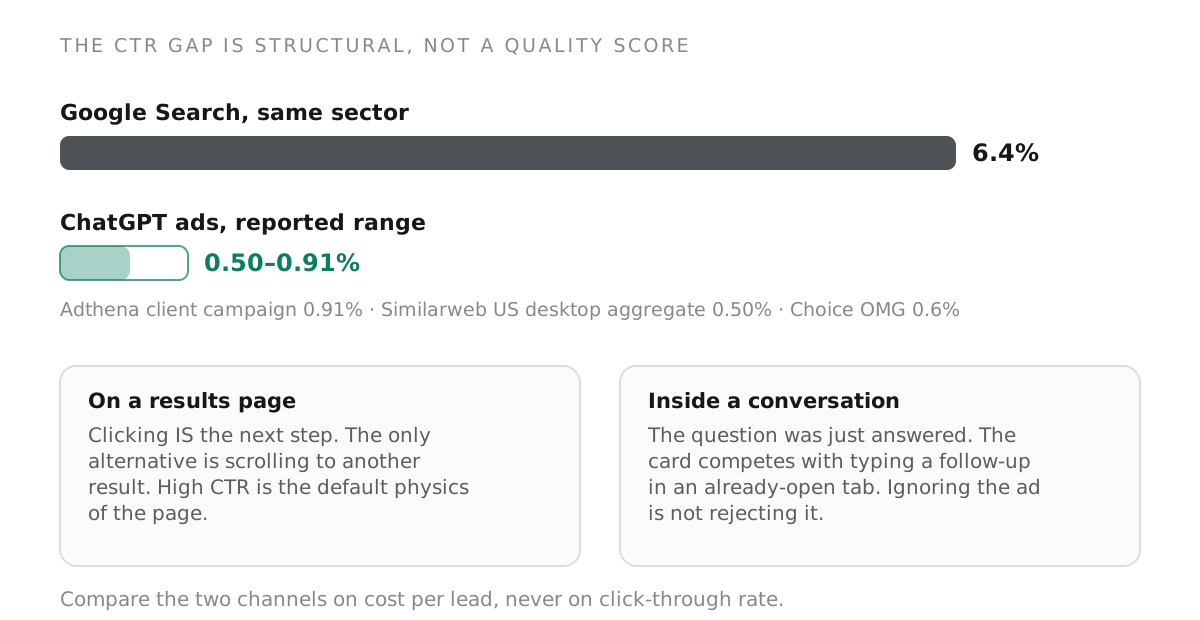
Line up what's actually been reported. The 0.91% ChatGPT figure against a 6.4% Google Search benchmark, same sector, came from a single Adthena client campaign (Campaign US, March 19, 2026). Separately, Similarweb measured a 0.50% aggregate click-through rate across US desktop ChatGPT ads on the Free and Go tiers in June 2026, reported by ppc.land on August 17, 2026. And on August 31, 2026, MediaPost reported a third, smaller data point pointing the same way: Choice OMG logged a 0.6% click-through rate across three campaigns in Ontario and Alberta, against ads it pegged at roughly 2% typical on search: 60 clicks around $7 each, and zero conversions. Three independent measurements, three methodologies, one direction. For reference, Google's own 2026 benchmark report puts average search click-through rate at 6.64% across 23 industries (WordStream, 2026). That's the same range as the 6.4% same-sector figure, arrived at independently.
The gap is structural, not necessarily a quality signal. On a results page, clicking is the next step toward the user's goal; there's no cheaper alternative besides scrolling to another result. Inside a conversation, the model has just answered the question, and the sponsored card is competing against a faster, already-open alternative: typing a follow-up instead of leaving the tab. A user who ignores a ChatGPT ad hasn't necessarily rejected it. They may be running the exact commercial research the ad targeted, just by asking the model another question instead of clicking away. Google's benchmark assumes clicking is close to the only path forward. ChatGPT's doesn't.
Which is the actual point: click-through rate is the wrong metric to compare these two channels on. It can't tell you whether ChatGPT ads are cheap or expensive per lead, because it isn't counting the same kind of event on each side. Zero conversions from a decent run of clicks (the Choice OMG result above) is itself a warning against treating either platform's CTR as a stand-in for lead quality. The comparison that actually matters is cost per lead, and that's what the method below is built to isolate.
The diagnostic asymmetry
Google gives you a search terms report: the actual typed queries responsible for a meaningful share of spend, tagged by match type, with the specific keyword that triggered each ad (Google Ads Help, August 2026). It isn't complete. Google has hidden low-volume search terms from the report since September 2020, citing user privacy, and one contemporaneous analysis found the change cut visibility into roughly 28% of paid search budgets (Search Engine Land, September 2020). But it still ties the bulk of spend to text an advertiser can act on: add a negative keyword, tighten a match type, rewrite an ad group around what people actually typed.
ChatGPT's dashboard shows aggregated impressions, clicks, click-through rate, cost per click, and conversions. That's the full list. There is no prompt-level report and no way to see which conversations triggered an ad (Search Engine Land, March 2026; eMarketer, March 2026). Ad matching runs on advertiser-submitted "context hints": plain-language thematic signals that OpenAI's own documentation says do not guarantee delivery in specific conversations, not a bid-per-keyword list (OpenAI Help Center, May 2026). If a hint is pulling in the wrong conversations, nothing in the reporting shows that happening. An advertiser only sees the downstream cost-per-lead number move, with no path back to a cause.
Even the settings governing how a conversion gets counted are partly undocumented. ChatGPT's view-through window is fixed at one day, not configurable. Its click-through window is configurable, but OpenAI has never published a default, a permitted range, or the mechanism for setting it. Some advertiser accounts show "30 days" in the interface, a figure with no documented backing anywhere in OpenAI's public materials (ppc.land, August 2026). That's an unusual gap for a platform running a billion-dollar annualized ad business, and worth saying plainly: nobody outside OpenAI has confirmed what that window actually does, account to account.
The practical cost shows up in mismatched numbers. MediaPost reported on August 31, 2026 that one agency, Cleverly, saw OpenAI's dashboard report 57 clicks against fewer than 20 Google Analytics visits from the same campaign; another, Camino5, ran a $1,000 test where ChatGPT-reported clicks produced no corresponding data in Analytics at all. One marketer quoted in that piece, Daniel Johnson, put it plainly: advertisers should treat any spend there "as a research budget" until the platform's own reporting can be trusted. A mediocre ChatGPT campaign and a badly broken one currently look identical from outside, because there's no lower-level report to tell them apart.
Mechanical differences that skew a naive comparison
Five platform mechanics change what a raw cost or performance comparison actually means. Miss any of them and the comparison is apples to a different fruit.
- Budget pacing changed mid-flight, quietly, on ChatGPT. Google has allowed campaigns to spend up to twice an average daily budget on high-traffic days for years, capped at 30.4 times that budget over a month (a stable, published mechanic every practitioner already prices in) (Google Ads Help, August 2026). ChatGPT Ads had a hard per-calendar-day cap starting May 22, 2026, then converted that cap into a seven-day rolling average the week of July 27, 2026 (nine weeks later, announced three days ahead, applied automatically to live campaigns), with the interface field still labeled
Daily budget(ppc.land, July 2026). A single day can now bill up to roughly twice the set budget as long as the week nets out, structurally similar to Google's flex, but nine weeks old and undisclosed in the product itself. More changes that landed this way are in our rundown of ChatGPT's silent platform changes.
- "Maximize results" is the new default bid strategy, with no documented override. As of the week of August 17, 2026, new ChatGPT ad groups default to an automated strategy that sets and adjusts bids toward whichever goal (clicks or conversions) the campaign is set to, without guaranteeing any specific cost per action, cost per click, or return on ad spend, and with no account-level override currently documented (ppc.land, August 2026). Google's automated bidding has years of published behavior behind it, plus a Manual CPC fallback every advertiser can select. Both platforms now default new campaigns to an algorithm. Only one lets you turn it off.
- Context hints replace keywords. There's no bid-per-keyword list on ChatGPT. Advertisers submit broad, plain-language thematic hints, and matching folds in the model's read of conversation intent along with the landing page and ad copy (OpenAI Help Center, May 2026). No keyword-level bid control exists, and no keyword-level report exists either: that's the mechanism behind the diagnostic gap above.
- No pixel-based retargeting exists yet. Site visitors who don't convert on a first ChatGPT ad click can't be retargeted the way Google or Meta remarketing works. The only audience tool is first-party list matching.
- Custom audiences carry a 25,000-user floor. That floor already dropped from an original 100,000, but list-matching systems generally see match rates of 20% to 40%. That means a raw list needs well over 25,000 records to reliably clear the threshold (OpenAI Help Center, August 2026). Most single-location or early-stage advertisers' buyer or high-intent lead lists won't qualify at all.
The method: a clean cost-per-lead comparison
Here's the test, stripped to what actually makes it honest.
- Same offer, same landing page structure, a dedicated path per channel. Not the same URL with a different UTM tag: a separate subdirectory or subdomain per channel. In-app click handling on ChatGPT strips referrers and UTM parameters on many paths, and the resulting traffic lands in Google Analytics as "Direct," disconnected from the platform's own click count. Route around it with server-side capture rather than trusting query strings to survive the trip; the full setup is in our attribution guide. Account and pixel setup is a separate, one-time prerequisite, covered in our account setup walkthrough; get that in place before the clock starts.
- Match the attribution windows, explicitly, not by default. Google's default is a 30-day click-through window and a 1-day view-through window, both editable per conversion action (Google Ads Help, August 2026). ChatGPT's view-through window is fixed at one day, not configurable; its click-through window is configurable, but check your own account for what it's actually set to rather than assume. OpenAI hasn't published a default or range. Set Google's click-through window to match whatever ChatGPT's account setting shows, exclude view-through conversions from both sides of the comparison, and write down the exact settings used. A comparison run under mismatched windows isn't a comparison.
- Cap it at two weeks, and cap the budget explicitly. Two weeks is a floor: long enough to cover a full weekly cycle, short enough to bound the damage if a rough day bills at roughly twice the daily rate described above. Set the spend cap above seven times your intended daily budget so a pacing day doesn't blow past what you planned to risk. Be honest about statistical power going in: a two-week window that produces single-digit leads is directional, not proof. If your Google cost per lead implies fewer than roughly ten leads over two weeks at the budget you're testing, extend the window before you extend your confidence in the result.
- Fund it enough to get a signal. Practitioner consensus, not an OpenAI-published figure, puts the floor for any usable read at roughly $1,000 to $1,500 a month. Treat that as an estimate, not a rule, and see what ChatGPT ads actually cost for how that floor compares to observed spend ranges. Below it, whatever the test produces is closer to an anecdote than evidence.
- Write the decision rule before looking at a single number. Put it on paper before launch: for example, keep testing or scale if two-week ChatGPT cost per lead comes in at or under 1.5x Google's cost per lead; drop it if it's above that and there's no specific, correctable cause you can point to. Because of the diagnostic gap above, you don't get the second lever a Google search-term cleanup would give you, so allow yourself exactly one adjustment (a landing page swap, a narrower context-hint set), not an open-ended tuning period, before the rule applies. Write the number down first. Once results are in, it's easy to find a reason to believe whatever you already wanted to believe.
We've built this same two-week-capped structure for a test campaign of our own in Denmark: decision rule written down, budget capped, not yet launched. Which is the discipline this piece is asking of you: write the rule down, then wait for the answer instead of narrating one early.
When Google stays primary regardless
A completed test can still leave Google as the default channel, independent of what the cost-per-lead number shows.
- Reach. ChatGPT ads now run in more than 40 countries as of August 31, 2026, on a $1 billion annualized revenue run rate roughly 200 days after the February 2026 launch (CNBC, August 2026). That's genuinely large, but still a fraction of Google Search's query volume, with under 20% of US ChatGPT users shown an ad on a given day. A five-figure monthly Google spend at a defensible cost per lead treats ChatGPT as test budget on top of that, not a replacement for it, today.
- Regional access. The European Economic Area plus Switzerland (31 markets) went live August 24, 2026, sold through agency partners only (Publicis, Omnicom, WPP, Havas, Dentsu, MediaPlus), consent-gated and unpersonalized, with no disclosed minimum spend; self-serve access for Europe only began rolling out on August 31, 2026, with no country-by-country dates published (Digiday, August 2026). An EU advertiser without an agency relationship or self-serve access yet can't run this test today: check whether your market has it before scheduling the two weeks.
- Restricted categories. Financial services, health services, and legal services sit in case-by-case manual review; legal services stay off-limits beyond general legal education (Search Engine Journal, April 2026). A quote-and-compare portal touching insurance or lending should expect friction here that doesn't exist on Google.
- Retargeting-dependent funnels. A model that leans on remarketing to site visitors who didn't convert the first time stays Google-first by construction, not preference, until ChatGPT offers something beyond the 25,000-user list-match floor described above.
None of this is fixed in place. Nearly every mechanical fact in this piece changed at least once between February and August 2026. If a first test comes back close, it's worth rerunning in a quarter rather than treating one two-week window as final.
Questions we keep getting
Is a 0.91% click-through rate actually bad?
Not by itself. It's low against the 6.4% same-sector Google Search benchmark, but the two numbers measure different user behaviors (see above). Click-through rate tells you whether people click, not whether the ones who click convert, or whether the ones who don't click were ever going to buy from you. Judge the channel on cost per lead, not click-through rate.
Can UTM parameters alone track this test?
No. In-app click handling strips referrers and UTM parameters on many ChatGPT paths, and that traffic lands in Google Analytics as unattributed "Direct" visits that don't reconcile with the platform's own click count. Use a dedicated landing path and server-side capture instead of relying on query strings to survive the trip.
What if I can't fund the estimated $1,000 to $1,500 monthly floor?
Treat whatever the test produces as an anecdote, not evidence. Either pool budget across a longer window or wait until you can fund it properly: a test below that floor is closer to a coin flip than a measurement, and the floor itself is a practitioner estimate, not a platform-published rule.
Does OpenAI's $1 billion run-rate milestone mean I should shift budget now?
No. Run rate measures OpenAI's growth trajectory, not your cost per lead. Platform scale and channel fit for your specific offer are different questions with different answers, and the only way to answer the second one is the test above.
How does targeting setup compare between the two platforms?
Google runs on keyword lists and match types with a bid attached to each keyword. ChatGPT runs on plain-language context hints with no bid-per-keyword control and no guarantee a hint delivers in any specific conversation. The full setup process, including how to structure ad groups around hints instead of keywords, is in our account setup guide.
Sources
- OpenAI: Testing ads in ChatGPT, February 2026
- Campaign US, 'Still finding its feet': Underwhelming early returns for ChatGPT Ads, March 2026
- eMarketer: ChatGPT ads will soon reach more users, but proven results are still missing, March 2026
- Search Engine Land: ChatGPT ads pilot leaves advertisers without proof of ROI, March 2026
- ppc.land: Similarweb opens AI ad data as 26% of ChatGPT replies carry sponsored ads, August 2026
- MediaPost: Data Reveals ChatGPT Ads Not Performing, August 2026
- ppc.land: ChatGPT Ads gains view-through conversions with a fixed 1-day window, August 2026
- ppc.land: ChatGPT ad budgets lose fixed daily caps 9 weeks after OpenAI set them, July 2026
- ppc.land: ChatGPT Ads makes automated bidding the default in new ad groups, August 2026
- Google Ads Help: About the search terms report, August 2026
- Search Engine Land: Google Ads to limit Search Terms reporting, citing privacy, September 2020
- Google Ads Help: About conversion windows, August 2026
- Google Ads Help: About overdelivery and your average daily budget, August 2026
- OpenAI Help Center: Create Ad Groups for ChatGPT, May 2026
- OpenAI Help Center: Set up Custom Audiences for your Campaign, August 2026
- CNBC: OpenAI's ad business shows blistering growth, hits $1 billion annualized revenue run rate, August 2026
- Digiday: OpenAI's ads business hits Europe at the six-month mark, August 2026
- WordStream: Google Ads Benchmarks 2026, August 2026