A ChatGPT ad is a labeled "Sponsored" card that appears below the answer, never inside it. OpenAI's policy for this, which it calls answer independence, states that paid placement cannot change the organic response in either direction: an advertiser cannot buy a better answer, and a competitor running ads cannot get you a worse one. That is a documented commitment, not a marketing line, and outside researchers have already measured whether it holds up.
Past that one policy, precision gets harder. Some of the mechanics are published in OpenAI's help center and policy pages. Others have been measured or inferred by third parties running accounts, scraping conversations, and comparing notes. A meaningful part of how the system actually behaves (the exact auction formula, the frequency-cap logic, why some accounts see more ads than others) is not published anywhere, by anyone.
A warning before the details: this system is six months old and half-documented. We flag which claims come from OpenAI, which come from outsiders measuring around the edges, and which are honestly unknown. If you are used to Google Ads, where auction insights sit one report away, the sheer amount of "nobody knows" here should change how much budget you commit, and how much you trust anyone who sounds certain.
Where the ad actually renders
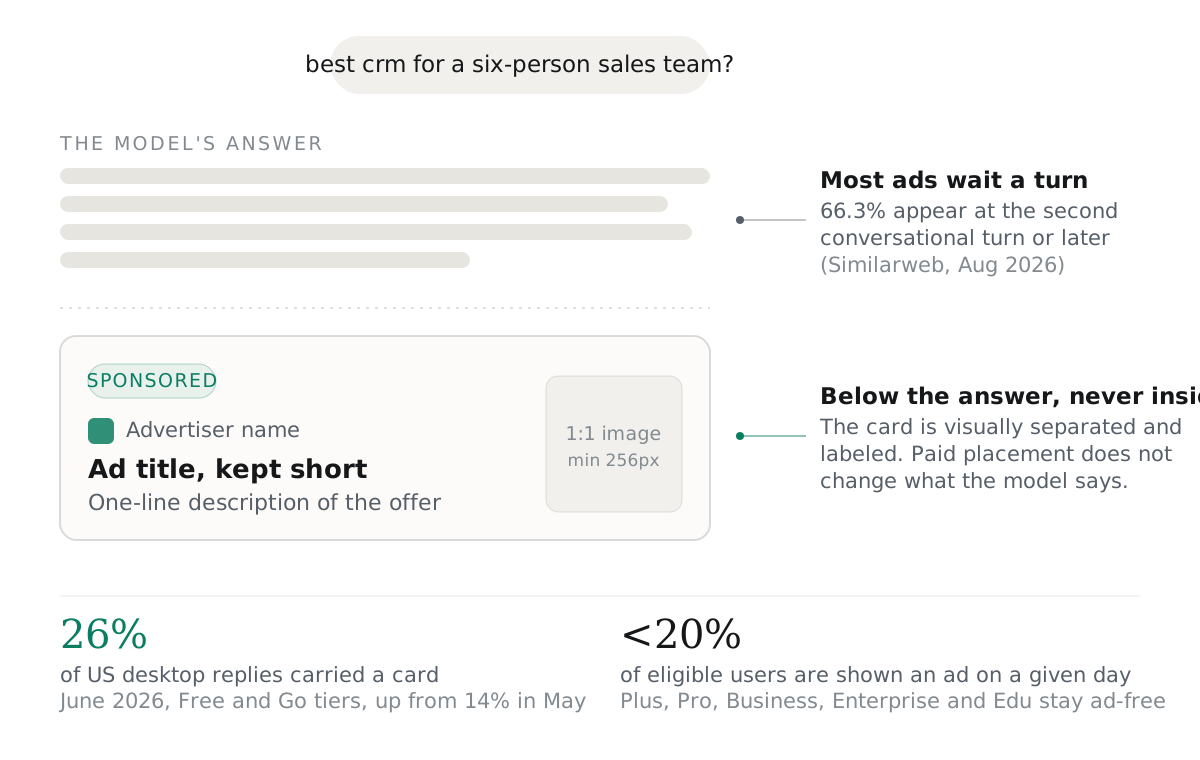
ChatGPT ads render as a card below the answer: advertiser name, a small favicon, a title, a short description, a landing URL, and one square image (minimum 256x256 pixels, JPG, PNG, or WEBP). The card is visually separated from the answer and carries a "Sponsored" label (OpenAI, February 2026). OpenAI does not publish official character limits for the title or description beyond telling advertisers to keep them concise. Third-party guides differ on the exact counts, so treat any specific character limit you see quoted elsewhere as someone's estimate, not a confirmed spec.
Two operational details matter more than the layout. First, most ads do not appear on the first message of a conversation. Similarweb's ad dataset puts the figure at 66.3% of ads appearing at the second conversational turn or later, based on ChatGPT Free and Go traffic (Similarweb via ppc.land, August 2026). If you are planning around a single opening query the way you might structure a Google Search ad group, that assumption does not hold here. The system appears to wait for commercial intent to firm up over a conversation rather than scoring a single first message.
Second, your landing page has to allow OpenAI's crawlers. The company runs OAI-AdsBot specifically to validate ad landing pages, and recommends also allowing OAI-SearchBot; block either one in robots.txt or at the CDN and ad review stalls, or an approved ad simply stops serving (OpenAI Help Center, August 2026). Anyone who already locked down bot traffic for security reasons (Cloudflare's bot-fight mode is a common culprit) should check this before submitting a first ad, not after a rejection notice.
Answer independence, checked against real data
OpenAI's own description of answer independence runs in both directions: an advertiser cannot pay to be recommended, and a business cannot be penalized in ChatGPT's answer because a rival happens to be running ads against the same conversation (OpenAI Help Center, August 2026).
An independent study backs this with numbers instead of just policy language. SE Ranking analyzed more than 50,000 commercial prompts across 20 niches and found that advertisers who won the sponsored card were also cited as a source in the organic answer only 3.63% of the time; an exact advertiser URL showed up in the answer's citations in just 0.09% of cases (Search Engine Land, August 2026). Plainly: buying a ChatGPT ad does not meaningfully improve your odds of being the brand ChatGPT talks about. That is a separate problem with a separate playbook: see organic AI visibility versus paid placement if citations, not clicks, are the actual goal.
Matching: context hints, not keywords
There is no keyword list to bid on. Advertisers write plain-language context hints describing what the product is, who it serves, and when it is useful. OpenAI's system weighs those hints alongside the ad's own title, copy, and landing page against the live conversation's topic and intent (OpenAI Help Center, August 2026). OpenAI is explicit that context hints are not exact-match controls: writing one does not guarantee the ad shows up whenever that topic comes up, and there is no way to exclude specific conversations either.
In the US, where self-serve buying has been open to any business since May 2026, matching can also draw on a user's past chats and prior ad interactions if that user has personalization turned on; users can turn it off, clear ad data, or move to a paid, ad-free tier. Custom audiences work by uploading a first-party list (email or phone) for matching, with a 25,000-user minimum before OpenAI will use it (down from an initial 100,000). There is no pixel-based retargeting of your own site visitors, so anyone arriving from Google or Meta expecting a "people who visited your site" audience will not find one yet (Jon Loomer Digital, July 2026).
In the EEA and Switzerland, the targeting model is different by design, not by omission. At the August 24, 2026 launch, personalization was off entirely, and buying ran only through OpenAI's ad-sales team and named agency partners: Publicis, Omnicom, WPP, Havas, Dentsu, and MediaPlus; self-serve buying only began rolling out a week later, on August 31, 2026 (Digiday, August 2026). Matching in the EEA and Switzerland runs on contextual signals only: the topic of the current conversation, an approximate location, device type, time of day, and language. Chat history and memory are excluded. OpenAI cites legitimate interest under GDPR as the legal basis for this contextual version, versus consent for the personalized version US users can opt into; OpenAI Ireland Limited is the data controller for EEA and Swiss users, and personalization is planned as a later opt-in step with no date attached (OpenAI, August 2026). If you run spend in both regions, treat them as two different targeting products sharing one interface: see our Europe-specific breakdown for what that means for setup.
One more thing worth flagging before you assume matching is purely topical: nothing currently stops a competitor's ad from showing when a user asks about your brand by name. Trade press documented an example in April 2026 of a fast-food chain's ad appearing on a prompt referencing a direct competitor by name, and could not determine whether that was deliberate targeting or a byproduct of topic matching (Search Engine Roundtable, April 2026). OpenAI does not currently give advertisers a way to exclude their own brand-name conversations from competitors' eligibility.
The auction: described, not confirmed
OpenAI has not published how its ad auction actually works. What exists instead is a consistent description from industry sources: a relevance-weighted second-price auction, where each eligible ad is ranked by a combination of the advertiser's maximum bid and a predicted relevance score built from the context hints, ad copy, and landing page; the winner typically pays close to whatever it takes to beat the next-best eligible ad, not its full maximum bid (WebFX, June 2026). Treat "relevance-weighted second-price" as the best outside description currently available, not as something OpenAI has confirmed in its own documentation.
What is documented is the entry point. Ads launched as CPM-only in February 2026, opening around $60 per thousand impressions. Cost-per-click bidding arrived April 21, 2026, with OpenAI recommending a starting maximum bid of $3 to $5 per click (Digiday, April 2026). Actual clearing prices have moved in both directions since, shaped by relevance and competition as much as by bid size. That is the real cost story, and it deserves its own treatment rather than a paragraph here: see what ChatGPT ads actually cost and measure your own number rather than importing someone else's benchmark.
Two changes since then are worth knowing about specifically because neither was announced as a change. Fixed daily budget caps quietly became a seven-day rolling average the week of July 27, 2026: a single day's spend can now run to roughly twice your set budget as long as the week nets out close to target (ppc.land, August 2026). And in August 2026, "maximize results" automated bidding became the default for new ad groups, with no published logic for how it spends and no documented account-level way to opt out (ppc.land, August 2026). Both are the kind of change you only catch by watching your account closely or reading trade coverage: see how ChatGPT ads change without notice for the fuller pattern.
Ad formats, including product feeds for ecommerce
The standard format is the single card described above: one image, one advertiser, one landing page. For ecommerce specifically, OpenAI added a product-feed format in May 2026: a retailer connects a structured product catalog, sets filters for which items are eligible to serve, and ChatGPT assembles the sponsored card automatically from the catalog's names, images, prices, and attributes, rather than the advertiser building a creative by hand for every SKU.
Trade coverage of the format is unusually candid about what it does not yet know. Even six weeks after the format existed, one detailed write-up flagged exact card dimensions, whether shopping data is ingested by feed, manual upload, or scraping, and how much control an advertiser has over which call-to-action button renders as open questions (North Country Consulting, June 2026). Treat any specific SKU ceiling or dimension spec you see quoted elsewhere as provisional until you confirm it directly against your own account. Full creative requirements are covered separately in our creative-specs reference.
How often an ad actually shows up
The honest answer: not very often, unevenly, and the measurement itself is disputed between vendors. Similarweb's dataset puts sponsored-card penetration on US desktop Free and Go traffic at 26% of replies in June 2026, up from 14% in May (Similarweb via ppc.land, August 2026). A separate study by SE Ranking, looking specifically at prompts carrying clear commercial intent rather than all traffic, found a near-identical 25.94%. That's worth noting as a coincidence, not a confirmation, since the two studies measure different denominators on different dates (Search Engine Land, August 2026). A third measurement firm, Adthena, reported zero ChatGPT ad placements across 169,560 UK searches in that same June window. "How often do ads show" does not yet have one number the industry agrees on.
At the user level, eMarketer cites an OpenAI spokesperson putting the figure at fewer than 20% of eligible users shown an ad on any given day. Against roughly 94.7 million US ChatGPT users, about 85% are ad-eligible in the first place: logged in, 18 or older, and on the Free or Go tier; Plus, Pro, Business, Enterprise, and Edu subscribers stay ad-free regardless of eligibility rules (eMarketer, March 2026).
An independent academic audit adds a third lens: a per-account view rather than a population snapshot. Researchers running 91 synthetic accounts through naturalistic prompts found a median of 14 days before an account's first ad exposure; once an account had been shown one ad, it went on to see ads on roughly 24% of its subsequent prompts (Lurie, Encarnación, Friedler & Metaxa, arXiv, August 2026). The same audit found retail and software categories accounted for 57% of all impressions collected. And, despite OpenAI stating advertisers have no demographic targeting available to them, accounts tied to lower-income ZIP codes received measurably more ads than higher-income ones. Nobody outside OpenAI has explained that pattern yet.
What nobody outside OpenAI knows
Some questions have no public answer at all, from OpenAI or from anyone measuring around the edges:
- The exact weighting between bid and predicted relevance in the auction. "Relevance-weighted second-price" describes the shape, not the formula.
- Whether there is a hard cap on ads per conversation or per session, and what sets it. The density numbers above describe outcomes, not the rule producing them.
- Why ad delivery correlates with income when no advertiser has access to demographic targeting to cause it.
- Whether a rejected ad has any appeal path. None is documented.
- Whether advertisers will ever get a prompt-level report. Today's dashboard shows aggregated impressions, clicks, CTR, CPC, and conversions only, with no view into which conversations triggered a given ad.
Assume any of this can change without a changelog entry, because the budget-cap and auto-bidding changes above already did.
Questions we keep getting
Can we target ChatGPT ads the way we target Google Ads keywords?
No. There is no keyword match type to bid on. You write context hints in plain language describing your product and audience, and OpenAI's system judges relevance; a well-written hint improves your odds but guarantees nothing, in either direction.
Does running a ChatGPT ad help our brand get cited in ChatGPT's organic answers?
The evidence says no. Independent measurement puts the overlap between "ran an ad" and "cited as a source in the same answer" under 4%, and under 0.1% for an exact URL citation. Ad spend and organic AI visibility are separate problems with separate playbooks.
Why did our daily budget get spent faster than we set it?
Daily caps stopped being strictly daily in July 2026. Budgets now run as a seven-day rolling average, so a single day can spend roughly double your set amount as long as the week averages out close to target. This was not announced as a change at the time it happened.
Can a competitor's ad show up when someone asks about our brand by name?
Nothing currently prevents it, and there is at least one documented example of it happening. OpenAI does not offer advertisers a way to exclude their own brand-name conversations from competitors' eligibility.
Is the European version the same product as the US one?
No. At launch, EEA and Swiss users see contextual-only ads with personalization off by default, a narrower set of targeting signals, and buying access that started sales-assisted before self-serve arrived a week later. Treat US benchmarks as a rough directional signal for Europe, not a substitute number.
Sources
- OpenAI, Testing ads in ChatGPT (February 2026)
- OpenAI Help Center, Ads in ChatGPT: The Basics (August 2026)
- OpenAI Help Center, Advertiser Guidance for Allowing OpenAI Web Crawlers (August 2026)
- OpenAI, ChatGPT Ads Expands Across Europe (August 2026)
- Digiday, OpenAI turns on cost-per-click ads inside ChatGPT (April 2026)
- Digiday, OpenAI's ChatGPT ads business hits $1 billion run rate as Europe gets self-serve access (August 2026)
- ppc.land, Similarweb opens AI ad data as 26% of ChatGPT replies carry sponsored ads (August 2026)
- ppc.land, ChatGPT ad budgets lose fixed daily caps nine weeks after OpenAI set them (August 2026)
- ppc.land, ChatGPT Ads makes automated bidding the default in new ad groups (August 2026)
- Search Engine Land, Study: ChatGPT ads appear on 26% of commercial prompts (August 2026)
- Lurie, Encarnación, Friedler & Metaxa, The Beginning of ChatGPT Ads (arXiv:2608.05008) (August 2026)
- eMarketer, FAQ on ChatGPT Advertising: Formats, costs, and early strategies to win (March 2026)
- WebFX, How Much Do ChatGPT Ads Cost? A 2026 Pricing Guide for Marketers (June 2026)
- Search Engine Roundtable, Example of Possible Competitor Targeting In ChatGPT Ads (April 2026)
- North Country Consulting, ChatGPT Ads for Ecommerce (June 2026)
- Jon Loomer Digital, Custom Audiences Come to ChatGPT Ads (July 2026)