On 24 August 2026, ChatGPT ads went live across 31 European markets: the 27 EU member states plus Norway, Iceland, and Liechtenstein under the European Economic Area, plus Switzerland. We could not find a single OpenAI announcement or news report that names all 31 countries in one place. What's public is the structure (27 plus three EEA states plus Switzerland) and a rotating set of examples (Germany, France, Spain, Italy, Poland, Sweden, Norway, Denmark, Ireland, the Netherlands) repeated across coverage without ever adding up to a complete list (Digiday, 24 August 2026; Adweek, August 2026).
One week later, on 31 August, OpenAI said its ad business had crossed a $1 billion annualized run rate in roughly 200 days and that self-serve access was starting to roll out to Europe, India, and the Middle East and North Africa (Forbes, 31 August 2026; Digiday, 31 August 2026). That is the headline. What matters is the part underneath it: what a European advertiser in a consumer niche (moving, home energy, travel, online education, e-commerce, comparison shopping) can actually act on this month, and what nobody outside OpenAI knows yet.
The short version. Personalization is off. Every ad in the EEA and Switzerland right now is picked from the live conversation topic, an approximate location, device type, time of day, and language: not from chat history, not from past ad clicks, not from a stored profile. Buying access is closed to self-serve for most advertisers; you reach the auction through OpenAI's own Ads Solutions team or one of six named agency partners, unless you're among the first let into the self-serve beta that started spreading across Europe this week. And there is no published EU cost number. None. Any CPC or CPM figure you see attached to "Europe" today is a US or UK number wearing a euro sign, or a guess.
The 31 markets, and the shape of the rollout
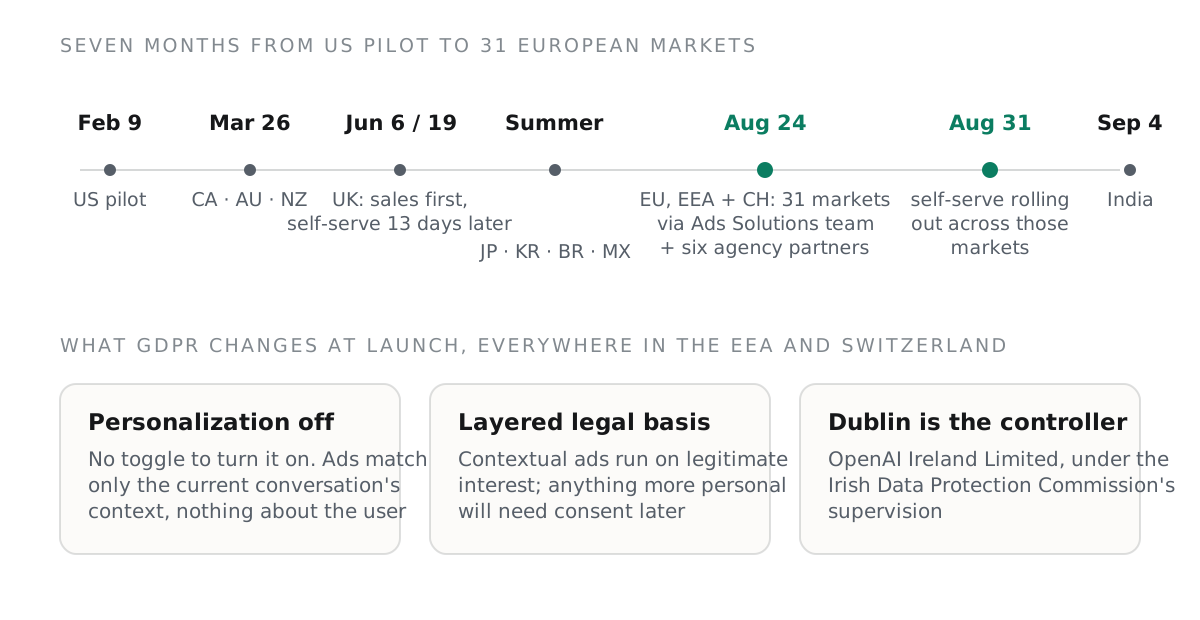
Switzerland is neither EU nor EEA, but this launch folds it into the same privacy and access rules as the other 30. OpenAI calls it the largest single geographic expansion of ChatGPT ads since the pilot began, moving the platform from roughly nine active ad markets to around 40 in one step (Digiday, 24 August 2026).
Ads only show to Free and Go tier users (the same restriction as everywhere else). Plus, Pro, and Enterprise subscribers see nothing. Go costs close to €7 a month in Europe, which is itself a data point: OpenAI has priced an ad-free European tier cheaply enough that "just pay to avoid ads" is a live option for price-sensitive users in a way it may not be in the US.
What's actually different from the US launch
Three things separate this launch from every prior market, and all three come from GDPR, not from product strategy.
First, personalization is off by default, with no toggle to turn it on yet. Non-personalized ads in the EEA and Switzerland are matched using only the current conversation's topic, an approximate location, device type, time of day, and language. Past chats, saved memories, and prior ad interactions are explicitly excluded. Personalized ads, which can use conversation and ad-interaction history elsewhere, are planned as a second step, opt-in only, with no announced date (Trending Topics, August 2026). The underlying targeting mechanics (how OpenAI matches an ad to a conversation, and what "context hints" advertisers supply instead of keyword lists) are the same auction logic covered in how ChatGPT ads work; Europe just runs a narrower input set through that system.
Second, the legal basis is layered. The baseline contextual ads everyone sees at launch run on GDPR's legitimate-interest basis: no opt-in prompt required, because the signals are limited to the live session rather than a profile built over time. The personalization layer OpenAI plans to add later will require affirmative consent instead. Coverage of this launch sometimes frames that as OpenAI choosing consent over legitimate interest overall, but more precisely it's consent for the future feature and legitimate interest for the one live today (Digiday, August 2026). Don't assume "GDPR-compliant" means one single mechanism here. Brief your legal team on both.
Third, OpenAI Ireland Limited, based in Dublin, is the data controller for EEA and Swiss users, with the Irish Data Protection Commission as the supervisory authority (a specific, checkable fact for your data protection officer's records).
Who can actually buy an ad right now
At launch on 24 August, buying was closed to self-serve. Bookings ran through OpenAI's own Ads Solutions team, through six named agency partners (Publicis, Omnicom, WPP, Havas, Dentsu, and MediaPlus), or through OpenAI's technology partners. No smaller or regional agencies were named. Self-serve access was promised only as "later this summer," with no firm date (Adweek, August 2026).
That changed, partially, on 31 August. OpenAI's Dave Dugan, VP of Global Ad Solutions, said self-serve access was opening to eligible advertisers in approved categories across Europe, India, and the Middle East and North Africa (Digiday, 31 August 2026). Read "eligible advertisers in approved categories" carefully: it's a rollout, not a light switch. Restricted categories like financial services, health, and legal went through case-by-case review even after self-serve opened in the US, and Europe has no reason to skip that step. Consumer niches like the ones this article is written for are plausible early candidates for direct access, but check your own account status rather than assume it.
Account setup mechanics (advertiser verification, billing entity, brand assets, the review layers your creative and landing page go through) don't change by market; setting up a ChatGPT Ads account walks through the process. What changes for European advertisers this month is simply whether you go through it directly or via one of the six named partners while you wait.
The data vacuum: why there is no EU number yet
Seven days after launch, there are zero published European CPC, CPM, or click-through benchmarks. Not low ones, not preliminary ones. None. One industry write-up put it bluntly the weekend before launch: no European CPM benchmarks exist yet, the market hadn't opened, and any number circulating before real campaigns run is a guess (Search Intel, August 2026).
We've built a capped test campaign for the Danish market ourselves; it isn't spending yet, so our numbers aren't in either. That's not a caveat specific to us: it's the actual state of the entire European market at seven to fourteen days old. Nobody's numbers are in yet, anywhere in the EU.
The UK is the closest thing to a proxy, and it's a limited one. The UK became the first European market for ChatGPT ads on 6 June 2026, running through OpenAI's own team before a narrower self-serve beta opened around 19 June (PPC Land, June 2026), and it crossed 1% of global ChatGPT ad impressions within its first week (a fast ramp for a single new market). But the UK isn't part of the 24 August rollout: it launched separately, on its own timeline, and its ad privacy policy already permits personalized ads for users who opt in, which the EEA and Switzerland don't offer at all yet. Treat UK numbers as directional at most, not substitutable; the same goes for US numbers, which is most of what exists. For the fuller US picture, see what ChatGPT ads cost.
What six months of US data suggests about how fast this fills in
The US pattern is the only real precedent, and it argues for the European auction thickening faster than most new ad channels do, with real texture, not a straight line.
Minimums collapsed fast. The US pilot opened 9 February 2026 as CPM-only, with a roughly $60 rate card and a $200,000–$250,000 minimum commitment reserved for enterprise buyers working through the sales team (OpenAI, February 2026). By around April that minimum had dropped to $50,000. Cost-per-click bidding arrived 21 April, with OpenAI recommending a $3–5 starting maximum bid. By 5 May, self-serve opened to any US business, the formal minimum was eliminated entirely, and campaigns could start around $25 a day (Axios, 5 May 2026). Four moves, three months: enterprise-only to anyone-with-a-credit-card.
The advertiser base grew alongside it. Similarweb's tracking panel counted the active advertiser base roughly doubling every four weeks from late March onward, reaching 3,770 brands active in the week ending 8 June, up 46% week over week, against 5,171 unique advertisers tracked all-time by that point. That's one panel's numbers, tracked consistently. A separate panel run by Sensor Tower shows a similar shape (30 advertisers in week one, over 600 by April, over 950 by May), but the two aren't directly comparable to each other, since they measure different things. By August, OpenAI itself described "tens of thousands" of advertisers active across more than 40 countries.
Pricing didn't move in one direction. CPMs actually softened from that initial ~$60 rate card toward an estimated $25–45 clearing range as inventory scaled: more free and Go users saw ads, and more replies carried one, so supply grew alongside demand. At the same time, individual reports show the gap between the advertised minimum and what competitive terms actually cost widening: one single-account benchmark clocked a $1.72 average CPC in mid-June (its own authors flagged this as one account, not representative), while an agency aggregate in late July put the average nearer $5, with a $2.50–$8.00 range, and one practitioner report in early August described an undocumented effective floor near $13 on competitive terms, well above the advertised $3 starting point (Grow My Ads, 3 August 2026). Translated: cheap broad averages coexist with an expensive, thickening fight for the specific terms everyone wants.
Two mechanical changes are also worth knowing before you set a European budget, because they'll almost certainly apply here too. Daily budget caps, introduced around 22 May as hard ceilings, quietly became a seven-day rolling average as of the week of 27 July, meaning a single day's spend can run roughly double the set daily figure as long as the week nets out (PPC Land, July 2026). And in August, automated "maximize results" bidding became the default for new ad groups, with undocumented logic and no account-level override (PPC Land, August 2026). A European advertiser opening their first account this month inherits both defaults on day one.
What an unpersonalized launch probably means for relevance and CTR
Here's a piece of reasoning, not a measurement, and we want to be explicit about the difference: nobody has published a European click-through rate, so the following is inference from how the system is built, not a result.
Contextual-only targeting is a strict subset of what's available once personalization is on. Fewer signals (conversation topic, rough location, device, time, language, and nothing else) generally means less precise matching between a given ad and a given user's actual intent, compared with a system that can also draw on chat history or past ad interactions. In search and social advertising, less precise matching has historically correlated with lower click-through, all else equal. If that pattern holds here, European click-through rates could plausibly run below whatever the equivalent US or UK contextual number is.
But "all else equal" is carrying real weight in that sentence, and it might not hold. Fewer advertisers are bidding into the same contextual slots in a brand-new market than in a mature one, which cuts the other way and could support higher relevance on average, at least early on, simply because there's less competition for attention within any given topic. Custom-audience matching (first-party list uploads, currently gated at a 25,000-user minimum where it's available) depends on the same personalization plumbing that isn't switched on in the EEA and Switzerland yet, so it's reasonable to expect that option isn't usable there either, though we haven't seen this stated outright anywhere. For US context on where click-through rates have landed so far (a range from roughly 0.5% to 1.2% across different single-account and aggregate reports, against a cited 6.4% for Google Search ads in a comparable sector), see what ChatGPT ads cost. None of those numbers transfers to Europe. Measure your own.
What to do this month if you sell into a European consumer niche
Four things are actionable now, independent of whether your self-serve access is live yet.
Get your landing pages crawler-ready. ChatGPT ads won't serve if OAI-AdsBot can't reach your landing page, and OpenAI also recommends allowing OAI-SearchBot. Check your robots.txt for an explicit allow, and separately check any CDN or bot-mitigation layer: Cloudflare, Akamai, and similar services often block crawlers by default even when robots.txt allows them. OAI-AdsBot is listed in Cloudflare's verified-bot directory, but your own custom rules can still catch it. This is a five-minute check that's worth doing before you're troubleshooting a rejected creative under deadline.
Instrument tracking before you need it, not after. The pixel setup uses an event ID and a server-side conversions interface; app events require the server-side path. Build for a known failure mode now: in-app click handling strips referrers and UTM parameters on many paths, so platform-reported clicks routinely don't reconcile with what your analytics shows as attributed traffic: one agency reported 57 platform-side clicks against fewer than 20 matching visits in its own analytics. There's also no prompt-level or search-term report, so if a campaign underperforms, you often can't see why, only that it did. Server-side capture, redundant UTM tagging, and a deliberate look at whether your "Direct" traffic bucket spikes when a campaign goes live are the closest things to a working diagnostic right now. ChatGPT ads tracking and attribution walks through the setup in more detail.
Decide your budget posture before the platform decides it for you. No EU minimum has been disclosed. US practitioner consensus (estimated, not official) puts $1,000–1,500 a month as roughly the floor for a signal-generating test and $5,000–10,000 a month as a more realistic baseline for drawing conclusions. Given the rolling seven-day budget average and the default automated bidding described above, set a cap you're comfortable seeing exceeded on any single day, not just on average.
Get in the queue, or check if you're already through. If direct self-serve access isn't showing in your account, the six named agency partners (Publicis, Omnicom, WPP, Havas, Dentsu, MediaPlus) or OpenAI's own Ads Solutions team are the only other way in as of this week. Given the pace at which self-serve expanded in the US (enterprise-only in February, open to any business by May), waiting a few more weeks for direct access may cost less than starting an agency relationship you don't otherwise need.
Questions we keep getting
Is self-serve actually open in the EU right now?
Partially, and unevenly. OpenAI said on 31 August that self-serve access was rolling out to eligible advertisers in approved categories across Europe. That is not the same as every advertiser in every category having access on day one. Check your own account status directly before assuming you need an agency.
Does "no personalization" mean a competitor's brand name can't trigger my ad next to it?
Not necessarily. Personalization off means no chat history or ad-interaction history is used. It says nothing about whether a competitor's brand name showing up in someone's conversation could surface your ad contextually. In the US, there are documented reports of a competitor's ad appearing alongside brand-name prompts for a different company. There's no confirmed EU equivalent yet, and no advertiser-side brand-safety or topic-exclusion controls have been documented in any market so far.
What should I budget for a first EU test?
Nobody can give you an EU-specific number honestly, because none exists. Use the US practitioner range (roughly $1,000–1,500 a month as a floor for a signal, $5,000–10,000 a month as a baseline) as a planning anchor, not a forecast, and expect your actual EU clearing price to differ from any US or UK figure you've seen.
Is the UK a reliable stand-in for EU numbers?
Directionally useful, not substitutable. The UK launched in June, months before this rollout, on its own track, and its privacy policy already allows opt-in personalized ads (an option the EEA and Switzerland don't have yet). Different targeting inputs plausibly mean different performance, in either direction.
Sources
- Digiday: OpenAI takes ChatGPT ads into Europe, August 2026
- Digiday: OpenAI builds offerings on consent as it expands ChatGPT ads to Europe, August 2026
- Digiday: OpenAI's ChatGPT ads business hits $1 billion run rate as Europe gets self-serve access, August 2026
- Adweek: OpenAI Is Taking Its Ad Business to 31 New European Markets, August 2026
- Trending Topics, OpenAI Confirms: ChatGPT Ads Will Launch in 31 European Countries Next Week, August 2026
- Forbes: OpenAI's ChatGPT Ads Hit $1 Billion Run Rate In Just 200 Days, August 2026
- Search Intel: ChatGPT Ads Europe, August 2026
- PPC Land: ChatGPT ads go live in the UK as OpenAI expands pilot beyond US, June 2026
- OpenAI: Testing ads in ChatGPT, February 2026
- Axios: OpenAI opens self-serve ad platform, May 2026
- PPC Land: ChatGPT ad budgets lose fixed daily caps 9 weeks after OpenAI set them, July 2026
- PPC Land: ChatGPT Ads makes automated bidding the default in new ad groups, August 2026
- Grow My Ads: ChatGPT Ads Review, August 2026