OpenAI's ChatGPT Ads business crossed $1 billion in annualized run rate this week, about 200 days after its February 9, 2026 launch, and is now live in more than 40 countries (Forbes, August 31, 2026). That's the headline. Underneath it, across the same six months, OpenAI changed how daily budgets work, made automated bidding the default for new ad groups, switched on client-side collection of hashed customer data by default, and rewrote its ad-eligibility policy at least four times. None of it arrived as a launch announcement. Most of it arrived as a line in a product-update email to beta advertisers, or a silent edit to a help-center article, days or weeks before trade press explained what had actually changed.
This isn't a complaint. Every ad platform moves fast in its first year: Google Ads did, Meta Ads did. The difference is that Google Ads' current behavior is documented and has been stable for years, so a media buyer can size a budget against it with confidence. ChatGPT Ads, six months in, can't make that promise yet. A budget cap configured in May runs on different math in August. A bid strategy nobody chose applies itself to every ad group created tomorrow. A tracking setting flips from off to on unless someone finds the toggle first.
None of that is a reason to skip testing ChatGPT Ads. It's a reason to test it assuming the ground will move, because the last six months say it will. Below: four dated changes OpenAI shipped with little or no advance notice, where to watch for the next one, and a two-week test structure sized to survive it.
What changed underneath advertisers since May
Daily budgets stopped being daily (May 22 to July 27)
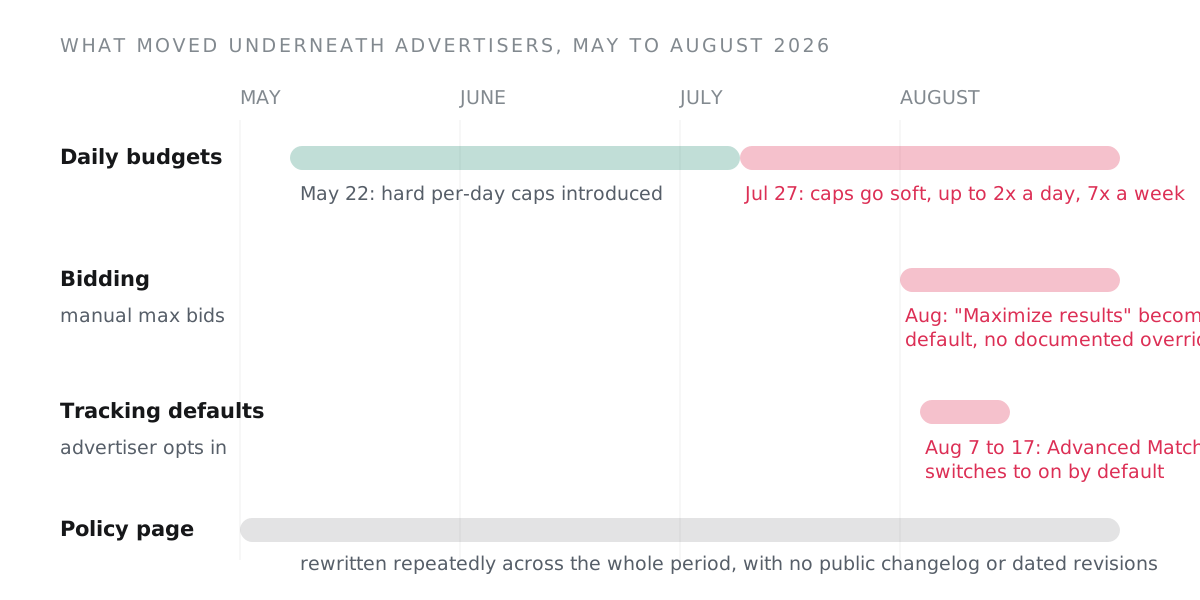
OpenAI introduced hard daily budget caps on May 22, 2026, alongside US geo-targeting: a fixed per-calendar-day ceiling on spend, the model most advertisers already assume from Google Ads. Nine weeks later, on July 24, OpenAI told beta advertisers by email that daily budgets would stop being a hard cap (PPC Land, August 2026). The change took effect the week of July 27: a daily budget became an average measured over seven days, with room to spend more on any single day as long as the week nets out.
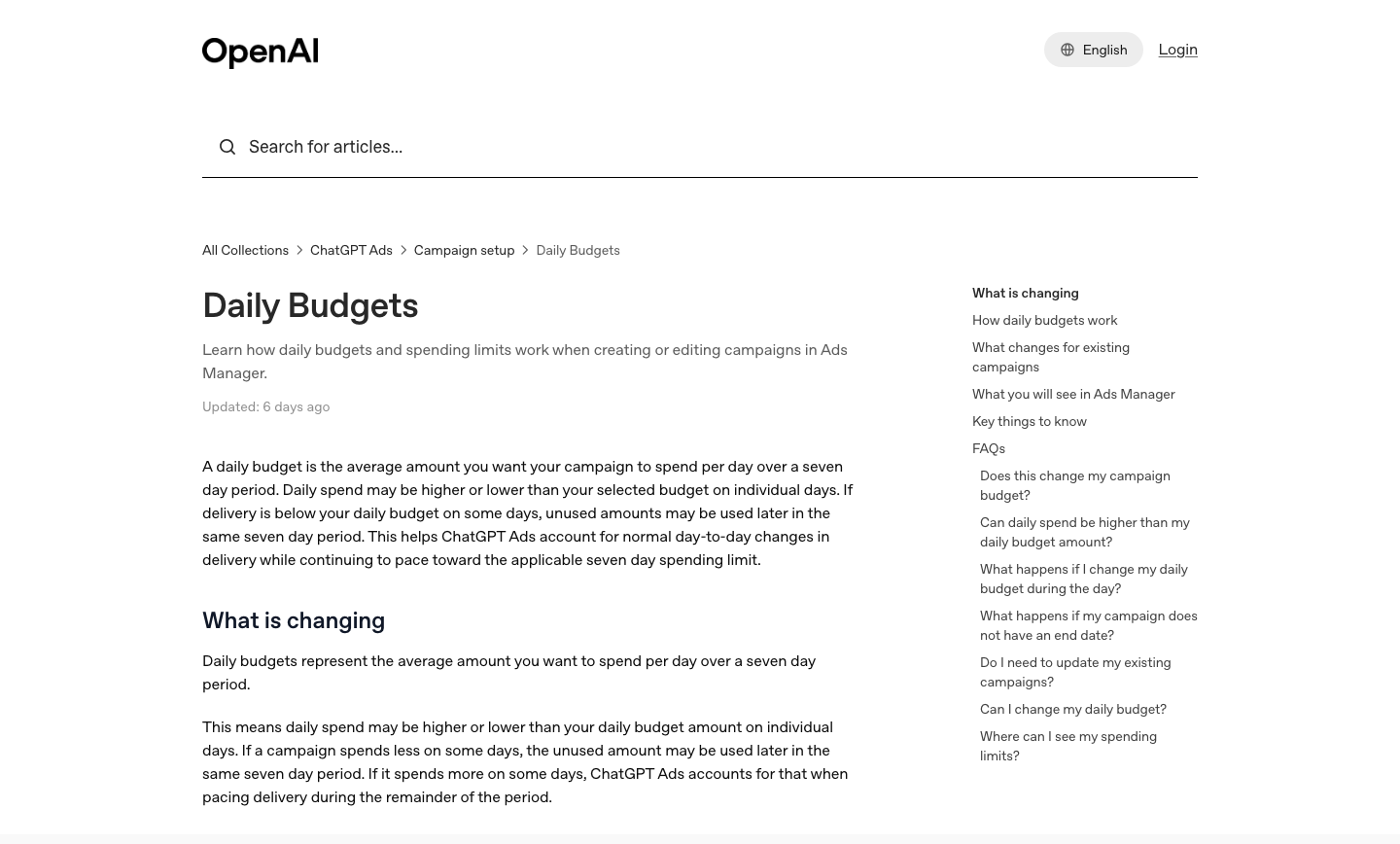
OpenAI's help-center article on daily budgets, updated around July 29, states the ceilings plainly: maximum single-day spend is twice the daily budget, and maximum seven-day spend is seven times it. Set a $100/day average and a single day can bill $200; a full week can bill up to $700: never more, but never as predictable as a flat $100 either.
Google Ads has run the same style of average-daily-budget model, with the same 2x single-day ceiling, for years, and every media buyer sizing a Google budget already prices that in. The issue here isn't the model. It's that it replaced a hard-cap system nine weeks after that system shipped, applied to live campaigns with no opt-out, and the multiplier math only became public through a help-center rewrite advertisers had to go find on their own.
Automated bidding became the default (August)
In August, OpenAI made Maximize results (an automated bid strategy) the default for new ad groups. The help-center documentation was updated around August 12 and announced to advertisers the week of August 17, listed first among six items in that week's product-update email (PPC Land, August 2026). The strategy sets and adjusts bids on the advertiser's behalf to return as many clicks or conversions as the budget allows. OpenAI's own documentation is direct about what it does not do: it does not promise a specific cost-per-click, cost-per-acquisition, or return-on-ad-spend outcome.
There's no account-level setting to turn this off once and have it stick. An advertiser can switch an individual ad group to a manual max bid, but the default reasserts itself on the next ad group they create. That means the choice repeats every time a campaign grows, and any advertiser who isn't checking bid strategy per ad group is running automated bidding by default without having decided to. OpenAI hasn't published what signals the strategy weighs or a way to see why it moved a bid. Set bid strategy correctly the first time, then check it again every time an ad group is added.
Ad tracking got riskier by default (August 7 to 17)
On August 7, PPC Land reported that Automatic Advanced Matching (a feature that hashes, client-side, the email, phone, name, and location a visitor types into a landing-page form and sends the hash back to OpenAI for conversion matching) would switch on by default for every existing pixel, with ten days to opt out. The deadline was August 17. Pixels created after the announcement had the setting on from the start.
The mechanism runs opt-out, not opt-in: do nothing, and it turns on. Turning it off means going into pixel settings and disabling it by hand. The practical effect is that an advertiser who does nothing now transmits hashed personal data to OpenAI for every form-fill their landing page collects. Whether that has a lawful basis under GDPR, UK GDPR, or a US state privacy law is the advertiser's problem, not OpenAI's: the toggle lives on the advertiser's account, so the compliance obligation sits with the advertiser regardless of which side of the default it started on. This setting lives in the same pixel and conversions setup covered in ChatGPT Ads tracking and attribution. Advertisers with a live pixel should check that toggle today, not on the next scheduled review.
The policy page keeps getting rewritten
Ad-eligibility rules for regulated categories have been revised at least four times since March 2026 (Search Engine Journal, August 2026): an April rewrite that ended the blanket exclusion of ads near medical, legal, and financial advice conversations; a July rework that spelled out which specific health and finance categories qualify, and in which markets; and an August 10-11 update adding real estate and job-listing platforms as eligible advertiser categories. The original February launch announcement described ads as excluded from sensitive or regulated topics broadly: language that reads as a wider restriction than the policy page that now actually governs approvals, which permits specific categories (health insurance, dental, supplements, vision, medical testing, hospitals and urgent care) while still banning legal-services ads outright except for general legal education. An advertiser who planned a campaign against the launch announcement, instead of the current policy page, planned against the wrong document.
None of this is unusual for a launch-year platform still finding where its lines sit. What's unusual is how quietly the lines move: no changelog, no version diff, no email to advertisers outside the category a given revision affects.
The expansion hasn't paused either. India got ads on Free and Go plans on August 28 (CNBC, August 2026); self-serve access there follows on September 4, at a daily minimum equivalent to about $7.60. Europe's 31-market launch on August 24 arrived through agency partners only: Publicis, Omnicom, WPP, Havas, Dentsu, and MediaPlus among them (Search Engine Land, August 2026). Self-serve access there is promised only as a loose end-of-summer timeframe, with no confirmed date. A platform still adding countries, currencies, and access tiers on a weekly cadence is not a platform where this week's account settings are a safe assumption for next week's.
This isn't new. It's just a new target
Earlier in 2026, before any of the above, advertisers were living through what trade press nicknamed budget purgatory: committed spend sitting 30 to 50 percent delivered against typical fill-rate expectations, some advertisers using less than a tenth of the $250,000 up-front commitments the pilot originally required (Digiday, June 2026). That was a capacity problem (not enough ad inventory to spend against), and it mostly resolved as OpenAI grew the number of conversations eligible to carry an ad. The pattern that hasn't resolved is the one that actually matters for a working advertiser: the mechanics you configure (budgets, bids, tracking, eligibility) keep changing shape after you've already built around them, and the change is usually visible in trade press before it shows up in your own account settings.
This is what a platform looks like at six months old. Treat it that way: not as a reason to avoid it, not as a betrayal when it moves, but as a fixed operating cost of testing here. Budget the checking time the same way you budget the ad spend.
What to check every week
Nothing inside ChatGPT Ads notifies advertisers when a default changes. The fastest way to hear about it (consistently faster than OpenAI's own help-center updates, based on the timeline above) is to read the outlets that cover this platform specifically. PPC Land and Search Engine Land both reported the budget-cap change, the advanced-matching default, and the automated-bidding default before, or in more detail than, any dedicated OpenAI announcement. Twenty minutes a week reading two sites is cheaper than finding out about a default change from a spend report.
Inside the account, re-verify four things weekly:
- Bid strategy per ad group. Confirm it's still set to what was chosen, not reset to Maximize results by a new ad group created since the last check.
- Budget type and math. Confirm "daily budget" is being read as a seven-day average with 2x/day and 7x/week ceilings, not as a hard cap, and that cash flow can absorb a 2x day.
- Advanced-matching toggle. Confirm it's set to what was intended, not to whatever it defaulted to after the last account or pixel change.
- Attribution window. Confirm the configured click-through window, and confirm the one-day view-through metric is still reporting separately from headline conversion and cost-per-acquisition numbers, not folded into them.
Screenshot all four the day a campaign launches. It's the only record of what the settings were before something changes them.
A two-week test built to survive this
Run a capped test, not an open-ended budget. Two weeks is long enough to see a pattern and short enough that a platform change mid-test doesn't wreck a quarter's spend.
- Size the budget for the 2x day, not the average. If losing $700 over two weeks would hurt, don't set a $50/day average: a single day at the documented ceiling is $100, and the test needs to survive that day without anyone pulling the card in a panic. Budget to the ceiling, not the sticker number.
- Write kill criteria before launch, not after the first week's numbers arrive. Pick a number in advance (cost per lead above a set threshold, or fewer than a set number of clicks by day seven) and write it down somewhere the whole team will actually look at again. A platform that changes its own defaults mid-flight is not the place to improvise a stop-loss rule in real time.
- Log daily, not weekly. Spend, clicks, and conversions from the ChatGPT Ads dashboard, next to what the site's own analytics shows for the same day. The two won't match exactly; in-app clicks on this platform are known to arrive at a site with no referrer or UTM parameter and land as Direct traffic in GA. A daily log is what separates a genuine platform shift from tracking quietly breaking mid-test.
- Screenshot every setting on day one. Bid strategy, budget type, advanced matching, attribution window, and anything else configured at launch. If a number moves in week two, this is what makes it possible to say, honestly, whether the campaign changed or the platform did.
We've built a capped test of our own in Denmark under this exact structure: settings screenshotted, kill criteria written down. It hasn't spent yet, so this isn't a results claim; it's the same discipline above, applied to our own account.
Size this against your own numbers, not ours
The number that matters when deciding whether a capped ChatGPT Ads test is worth running is a Google cost-per-lead that's already known: not a claim from us, not a benchmark from an agency blog with an undisclosed sample, and not OpenAI's own recommended starting bid. What ChatGPT Ads actually cost lays out the dated CPC and CPM figures various accounts have reported; all of them are thin, all of them are attached to one account and one date, and none of them is a promise about any other account. Run the test above, log the resulting cost per lead against the existing Google number, and decide from that.
Questions we keep getting
Why doesn't OpenAI just publish a changelog?
Unclear. Nobody outside OpenAI knows why. What exists today is a mix of help-center article edits, some carrying no visible timestamp in the interface and datable only by comparing versions over time, and product-update emails sent to beta advertisers that don't appear to be archived anywhere public. Trade press fills the gap by comparing page versions and reporting on the emails.
Should we wait until the platform is more stable before testing?
That's a reasonable choice, and nobody can say it's wrong. But "stable" has been a moving target for six straight months with no sign of settling: inventory, geography, bidding, and tracking are all still moving. If a Google cost-per-lead is the number a business is trying to beat or diversify away from, waiting has a cost too. A capped two-week test bounds the downside either way.
Does Maximize results mean there's no control over cost per click?
No. Any individual ad group can be switched to a manual max bid. What's not available is a permanent account-level default: the choice resets to automated on every new ad group, so it has to be checked each time, not set once and forgotten.
Does turning off Automatic Advanced Matching lose conversion tracking?
No. Advanced matching improves match rates on top of an existing pixel and conversions API setup; it doesn't replace them. Turning it off means relying on existing tracking without the added hashed-data matching layer, a reasonable default for any advertiser who hasn't confirmed a lawful basis for sending hashed personal data collected through their own forms.
How is this different from how Google Ads or Meta Ads change over time?
Scale and documentation. Google and Meta change constantly too, but each maintains a public changelog, and their current defaults are documented precisely enough that a media buyer can build a budget model on top of them. The comparison is laid out in ChatGPT Ads vs. Google Ads. ChatGPT Ads has been live about six months. Parts of its current behavior are documented only in a help-center article an advertiser has to know to go looking for, updated on a date nobody announces.
Sources
- PPC Land: ChatGPT ad budgets lose fixed daily caps 9 weeks after OpenAI set them, August 2026
- PPC Land: ChatGPT Ads makes automated bidding the default in new ad groups, August 2026
- PPC Land: ChatGPT advertisers face 10 days to opt out of automatic advanced matching, August 2026
- PPC Land: Bid controls shrink as ad measurement breaks: week of August 17, August 2026
- OpenAI Help Center: Daily Budgets, July 2026
- Search Engine Journal: OpenAI Allows Some Health & Finance Ads In ChatGPT, August 2026
- Search Engine Land: ChatGPT Ads are expanding to 31 European countries, August 2026
- Digiday: ChatGPT ad delivery struggles are testing advertiser patience, June 2026
- Digiday: OpenAI's ChatGPT ads business hits $1 billion run rate as Europe gets self-serve access, August 2026
- Forbes: OpenAI's ChatGPT Ads Hit $1 Billion Run Rate In Just 200 Days, August 2026
- CNBC: OpenAI rolls out ads on select ChatGPT plans in India, August 2026
- OpenAI: Ad policies, August 2026