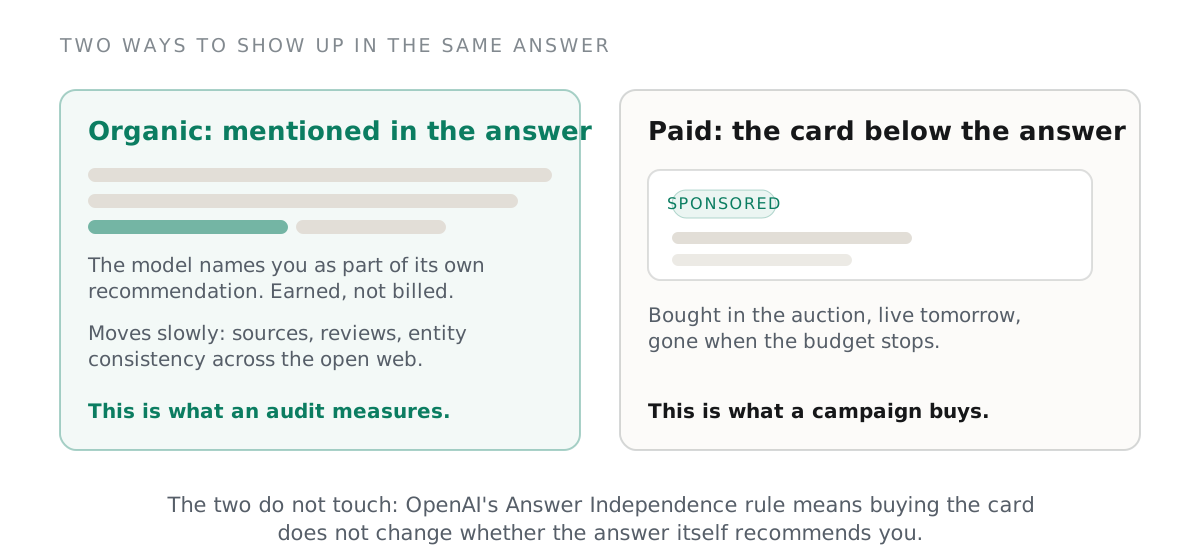
Organic AI visibility and ChatGPT Ads are two different systems that happen to render in the same conversation. One is what the model says about you for free, unprompted, when a buyer asks a question in your category. The other is a labeled "Sponsored" card OpenAI sells you, placed below that same answer. OpenAI's policy (it calls this "answer independence") is that the two never touch: paid placement cannot change the free answer above it. That single design choice is why you have to measure both lines, separately, before spending on the second one.
The consequence is blunt. If the model already recommends you when a buyer asks, an ad is incremental: extra shelf space next to a mention you already have. If it doesn't recommend you, the ad is not a supplement to anything. It is your entire presence in that conversation, sitting under a label users read as "paid," while a named competitor may occupy the free answer above it. Those are two different budgeting decisions, and you cannot tell which one you're making until you check.
ChatGPT Ads is no longer a rounding error: OpenAI reported a $1 billion annualized run rate around day 200 of the product, live in more than 40 countries, as of August 31, 2026 (CNBC, Aug 2026). That number describes the paid line. It says nothing about your organic one. Below: how organic recommendations form, why the commercial-intent figures you've seen quoted are probably not comparable to each other, how to test whether ChatGPT, Gemini, and Claude actually name you, and what's different in the EU.
How organic recommendations actually form
A free ChatGPT answer draws on up to three inputs, and only one of them has a submission form attached to it.
Training data. The model's weights encode a snapshot of public web and licensed content as of a training cutoff. If your business has a footprint online (press coverage, review sites, forum threads, comparison articles, your own site), a model trained after that footprint existed has some chance of having absorbed it. This layer updates only when OpenAI ships a new model version. You cannot edit it directly, and OpenAI has not published what within that footprint counts for more than anything else.
Live retrieval. Not every query triggers a live web search: a meaningful share are answered straight from training data, and OpenAI hasn't published the split. When retrieval does trigger, three separate crawlers handle three separate jobs, each independently controllable through robots.txt: GPTBot collects content for training, OAI-SearchBot builds the index live search retrieves and cites from, and ChatGPT-User fetches a page because a user's action asked it to (Anagram, 2026). You can block training while staying eligible for citation in search-triggered answers. None of this is the ad system; ads sit below whatever this machinery produces (mechanics in full: how ChatGPT ads work).
Structured product data. This is the one lever with a submission form, and it predates ChatGPT Ads. On September 29, 2025 (four and a half months before the first ChatGPT ad ran), OpenAI and Stripe launched Instant Checkout, letting US users buy from Etsy sellers inside a chat on an open standard called the Agentic Commerce Protocol (Stripe, Sept 2025). Merchants feed OpenAI a structured catalog (title, price, availability, images), and guides tracking the spec describe the listings as unpaid, ranked on feed quality, product relevance, and user context (Lengow, 2026). Instant Checkout itself was retired March 24, 2026, replaced by a handoff model: ChatGPT surfaces the product, the buyer completes the purchase on the retailer's own site (Enterprise DNA, Mar 2026). The feed survived: as of June 2, 2026, OpenAI folded feed setup into the same self-serve interface it uses for ads. Submitting a feed isn't a purchase. Turning it into a paid card is a separate step, via the shopping ad format added around May 12, 2026.
If you sell physical products, that feed is worth setting up regardless of whether you ever buy an ad. If you sell a service (moving a household, installing a heat pump, running a comparison portal), there is no published equivalent. A mover doesn't have a SKU catalog. For that half of this audience, organic surfacing runs entirely on training data and live retrieval: the same category of signal that already feeds a Google local pack, minus any OpenAI confirmation that it's weighted the same way here.
Be clear about what's undocumented. OpenAI has named three factors for the narrow shopping-feed case. It has not published a ranking method for the far more common case: a free-text recommendation naming one mover, one installer, one course provider over another. Nobody outside OpenAI has described that weighting publicly. Anyone handing you a specific checklist for it is guessing.
The commercial-intent number nobody agrees on
You'll see a figure cited for "what percent of ChatGPT queries have commercial intent." Treat every one of them as specific to its own study, not as a fact about the platform.
OpenAI's own framing, from VP of Ads Dave Dugan at Cannes Lions in June 2026: roughly 20% of ChatGPT queries carry direct commercial intent (Marketing Dive, Jun 2026). An independent analytics firm, Measure Protocol, put it at 21.6% of interactions showing some commercial intent, with 7.1% classified as high-intent, based on roughly 143,000 ChatGPT sessions collected January through June 2025 (Adweek, Oct 2025). Those two land close together, eight months and two different organizations apart.
Now the range collapses. The research firm Profound published 9.5% commercial intent (plus a separate 6.1% "transactional" category) in June 2025 (Profound, Jun 2025), using a taxonomy where "generative" queries outnumbered both. A year later, using a redefined, mutually exclusive taxonomy over 7.5 million conversations, Profound reported commercial intent had risen from 13.9% to 19.2% over that same year (Profound, Aug 2026). That's a different number for the same company, because the definition changed underneath it. At the other end, an analysis of 680 million citations found 73% of B2B buyers now use AI tools including ChatGPT somewhere in their research process (Yahoo Finance / Averi, Mar 2026). That's a buyer-adoption rate, not a query classification.
Nine and a half percent. Twenty-one point six. Seventy-three. All defensible, all about the same platform, all measuring something different: per-query versus per-conversation versus per-buyer, all-commercial-signal versus high-intent-only, an internal chat classifier versus a citation-adoption analysis.
No consensus number exists. Importing one into your own funnel math is a guess dressed as a data point.
What matters isn't the platform average. It's whether your buyers' specific questions get you named, and that's a number nobody but you can produce.
How to find out whether you're actually recommended
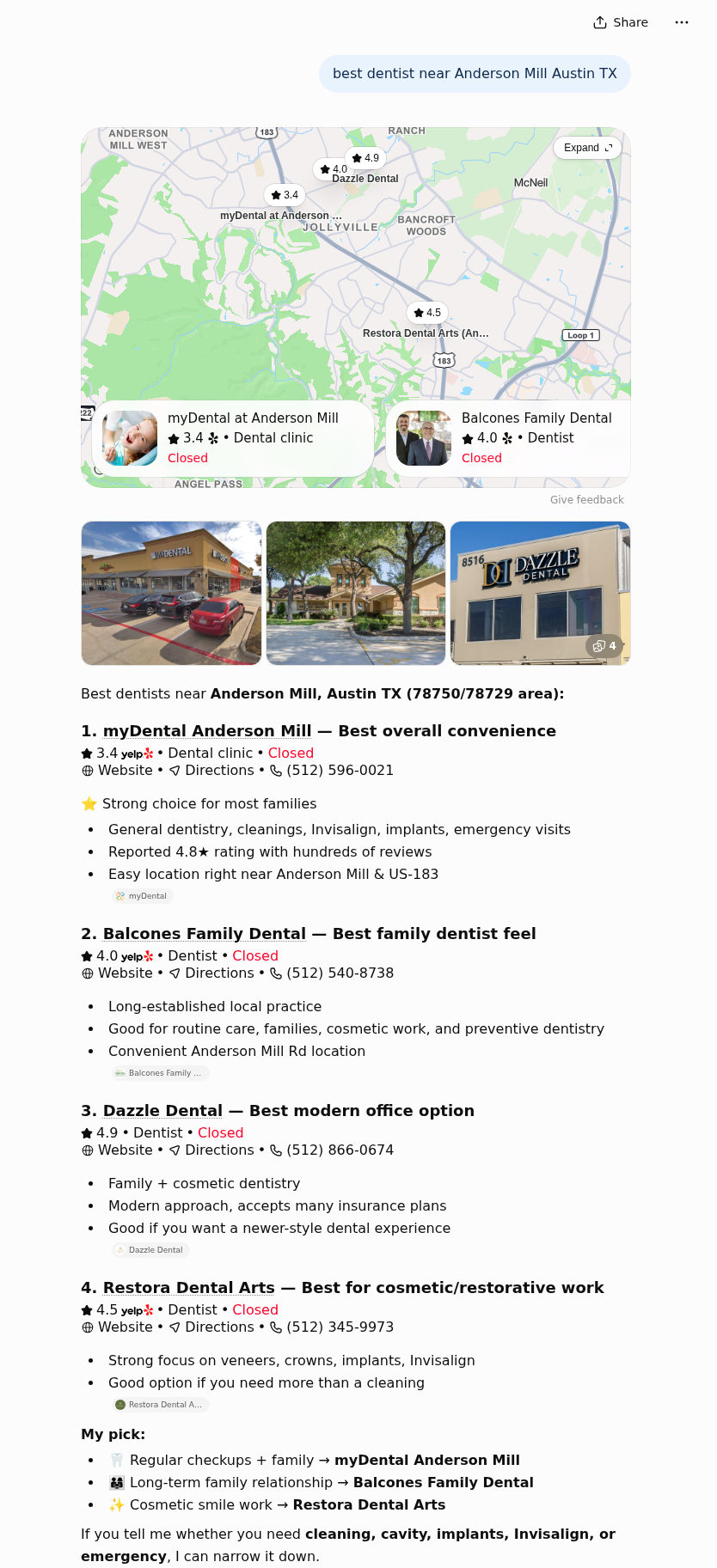
Start from a fact that should lower your confidence in any dashboard: even businesses paying OpenAI directly for ads can't see the conversation that triggered their own ad impression. The reporting interface shows impressions, clicks, CPC, and conversions, but never the prompt behind them (Search Engine Land, Mar 2026). If paying customers can't see the query, you have no chance of inferring your organic status from anything you already own. You have to generate the questions yourself and read what comes back.
The method isn't complicated, but it has to run the same way every time:
- Write real buyer questions, in your category and your specific city or market, not your brand name, not an abstraction like "best moving companies." Use the actual shape of a buying question: "best movers in Austin for a two-bedroom apartment," "heat pump installers near Leeds who handle grant paperwork," "online UX bootcamps under $5,000, compared." Build a fixed list, somewhere around 15 to 30 questions, and don't edit the wording once the list exists.
- Run each one fresh (logged out, or in a new session with no chat history) across ChatGPT, Gemini, and Claude, separately. "Fresh" matters because personalization and saved history change what comes back, and a logged-in test with months of history isn't what a new prospect sees. It also matters because these are three independently trained models with independent retrieval behind them, so a mention in one tells you nothing about the other two.
- Log every run: model, date, exact prompt text, full response text, screenshot. Word for word, not a paraphrase of what you remember reading.
- Score it. Does your business appear at all? Named first, buried in a list, or absent? Which named competitors show up alongside you?
- Repeat the identical list on a fixed schedule. Monthly, not quarterly (see below for why). Track the change between runs, not just the latest snapshot.
A few failure modes worth planning around. A single favorable run is an anecdote: outputs vary between runs on identical prompts, so one good screenshot proves nothing; run each question more than once per cycle. Wording is sensitive: rephrasing a question can change who gets named, so fix the phrasing and leave it alone rather than testing until you find one that flatters you. Geography doesn't generalize: a business named for its largest market may be invisible in a smaller one, so test each city separately. And track competitors, not just yourself: a rival's content push can show up in your buyer-question answers before it shows up in your own traffic.
This is the same fixed-question, repeat-run design our audit and monitor products run on: the audit is a one-time pass through this method, the monitor repeats it on a schedule and tracks what moved.
Why the measurement has to come before the spend
The audit sorts you into one of two situations, and they call for different budgets.
If you already appear for most of your buyer questions, an ad is incremental: extra reach next to a mention you already have. That's a normal marginal-spend decision, no different from adding a second Google Ads campaign. If you don't appear, or a named competitor does and you don't, the ad isn't a top-up. It's the only place you exist in that conversation, under a "Sponsored" label that gets clicked less than an organic answer: one study found 0.91% click-through against 6.4% for Google Search ads in the same sector (eMarketer, Mar 2026, single-client data); a broader aggregate across US desktop Free and Go conversations measured 0.50% in June 2026 (Similarweb via PPC Land, Jun 2026). Low click-through isn't necessarily a defect (a conversational answer replaces a click with a read), but if the ad is your only presence, that low number is close to your entire yield. Full comparison: ChatGPT Ads vs. Google Ads.
On price, report the trajectory and stop there. OpenAI's rate card opened at roughly $60 CPM when testing began February 9, 2026, enterprise-only, with a $200,000–$250,000 minimum (OpenAI, Feb 2026). Cost-per-click bidding arrived April 21, 2026, with a recommended starting bid of $3 to $5 (Digiday, Apr 2026). Some accounts have cleared below that: $1.72 average on one $60,000 spend over 15 days in mid-June 2026, a single account, not a benchmark. Others describe an undocumented effective floor closer to $13 on competitive terms as of early August. We won't tell you the new auction undercuts Google. Nobody outside your own account knows that yet. Full trajectory: what ChatGPT Ads cost.
Measuring first isn't about talking yourself out of an ad budget. It's about knowing which situation you're actually in before you set one.
What's different in the EU
ChatGPT Ads reached 31 European markets on August 24, 2026: the 27 EU member states plus Norway, Iceland, and Liechtenstein, plus Switzerland (Adweek, Aug 2026). Unlike the US rollout, it launched unpersonalized: no targeting on chat history or past ad interactions, contextual signals only (topic, approximate location, device, time, language) under GDPR's "legitimate interest" basis, with OpenAI Ireland Ltd as EU data controller (Trending Topics, Aug 2026). OpenAI VP of Ads Dave Dugan framed the launch as "upholding our principles of answer independence, privacy, and user choice and control" (Digiday, Aug 2026). That's the same principle covered above, restated for a market where personalization is off by default.
Access is narrower too. At launch, EU advertisers reached the product only through OpenAI's own ad-sales team and a named list of agency partners: Publicis, Omnicom, WPP, Havas, Dentsu, MediaPlus (Digiday, Aug 2026). Self-serve access only began rolling out market by market from August 31, 2026 (CNBC, Aug 2026).
There are no published EU benchmarks (no CPC, no CPM, no CTR) because the market is days old (Search Intel, Aug 2026). Any EU figure you see quoted is extrapolated from US or UK data, not measured. The UK is the closest proxy (it launched separately in June 2026 and crossed 1% of global ad impressions within its first week), but it sits outside GDPR post-Brexit, so even that number is directional. We've built a small ChatGPT Ads test of our own in Denmark; it isn't spending yet, which is roughly the state of EU benchmarks generally. Full detail: ChatGPT Ads in Europe.
The practical consequence for this audience is sharper than the US version of this story. Self-serve isn't open in most of the EU yet, and the agency-only lane's minimums aren't public. An EU-based mover, energy installer, or comparison portal can't simply decide to buy a targeted ChatGPT ad this week: the lane isn't fully open regardless of budget. Until it is, the organic measurement above isn't just your baseline for when you eventually turn ads on. For most EU businesses right now, it's close to the only lever available inside ChatGPT at all.
Questions we keep getting
Does buying ads improve our organic recommendation rate?
No. Answer independence is explicit policy: paid placement does not change the free answer rendered above the ad card (OpenAI, Feb 2026). Buying an ad gets you the ad. It does not get you named inside the answer itself.
How often should we re-run the audit?
Monthly, not quarterly. The paid side of this product changes fast enough to make quarterly checks a bad habit: the ad policy page has been revised at least four times between February and August 2026 (abmatic.ai, May 2026), and daily budget caps silently became a seven-day rolling average nine weeks after being set (PPC Land, Jul 2026). The organic side is a separate system, but a platform moving this fast on one side is reason enough to check the other monthly rather than assume it holds still.
We sell a service, not a product. Does the product feed apply to us?
No. The feed is a catalog mechanism for SKUs: titles, prices, inventory. A moving company or a solar installer has no catalog to submit, and there's no published service-side equivalent yet. Your organic visibility runs on training data and live retrieval only.
Is one good mention proof that we're visible?
No. Outputs vary run to run on identical prompts. One favorable screenshot is an anecdote. Run each question more than once per cycle, and look for a pattern across runs, not a single result.
Should we wait for EU self-serve before doing anything?
No. The measurement described above doesn't require an ads account of any kind. Run the buyer-question audit now, in whatever market you sell into, regardless of when (or whether) self-serve ads reach you.
Sources
- CNBC: OpenAI's ChatGPT ads business hits $1 billion run rate, August 2026
- Stripe: Stripe powers Instant Checkout in ChatGPT, September 2025
- Enterprise DNA: OpenAI kills Instant Checkout, Agentic Commerce Protocol replaces it, March 2026
- Lengow: ChatGPT Product Feed specification, 2026
- Marketing Dive: What defines ChatGPT ads? OpenAI tells Cannes, June 2026
- Adweek: Measure Protocol finds over one in five ChatGPT conversations show commercial intent, October 2025
- Profound: AI search intent study: what 50M+ ChatGPT prompts reveal, June 2025
- Profound: Commercial conversations in ChatGPT more than doubled in a year, August 2026
- Yahoo Finance: 73% of B2B buyers use AI tools in purchase research, Averi analysis, March 2026
- Search Engine Land: OpenAI's ad platform can't tell advertisers if their money is working, March 2026
- OpenAI: Testing ads in ChatGPT, February 2026
- Digiday: OpenAI turns on cost-per-click ads inside ChatGPT, April 2026
- Digiday: OpenAI's ads business hits Europe at the six-month mark, August 2026
- Adweek: OpenAI is taking its ad business to 31 new European markets, August 2026
- Trending Topics: OpenAI confirms ChatGPT ads will launch in 31 European countries, August 2026
- Search Intel: ChatGPT Ads in Europe, August 2026
- eMarketer: FAQ on ChatGPT advertising: formats, costs, early strategies, March 2026
- abmatic.ai: OpenAI ads policy approval guide, May 2026
- PPC Land: ChatGPT ad budgets lose fixed daily caps nine weeks after OpenAI set them, July 2026