OpenAI's ad policy has been revised at least four times since the first ChatGPT ad test went live on February 9, 2026. Most advertisers read it once, if that. They learn what's actually allowed by submitting a campaign and waiting for a verdict. That's an expensive way to discover your category needs a different process than the one you budgeted for.
Here's the short version. Moving and relocation, home energy, online education, travel, comparison and quote portals, e-commerce. None of that is restricted. You go through the same review as everyone else, and the door has been open since launch. Financial services, health services, and legal services sit in a separate tier: case-by-case manual review, no published timeline, and, so far, no documented way to appeal a rejection.
Consider this the map (banned, restricted, and how the lines keep moving), drawn so you find out where you stand while budgeting, not from a rejection email three weeks before launch.
The categories that can't advertise at all
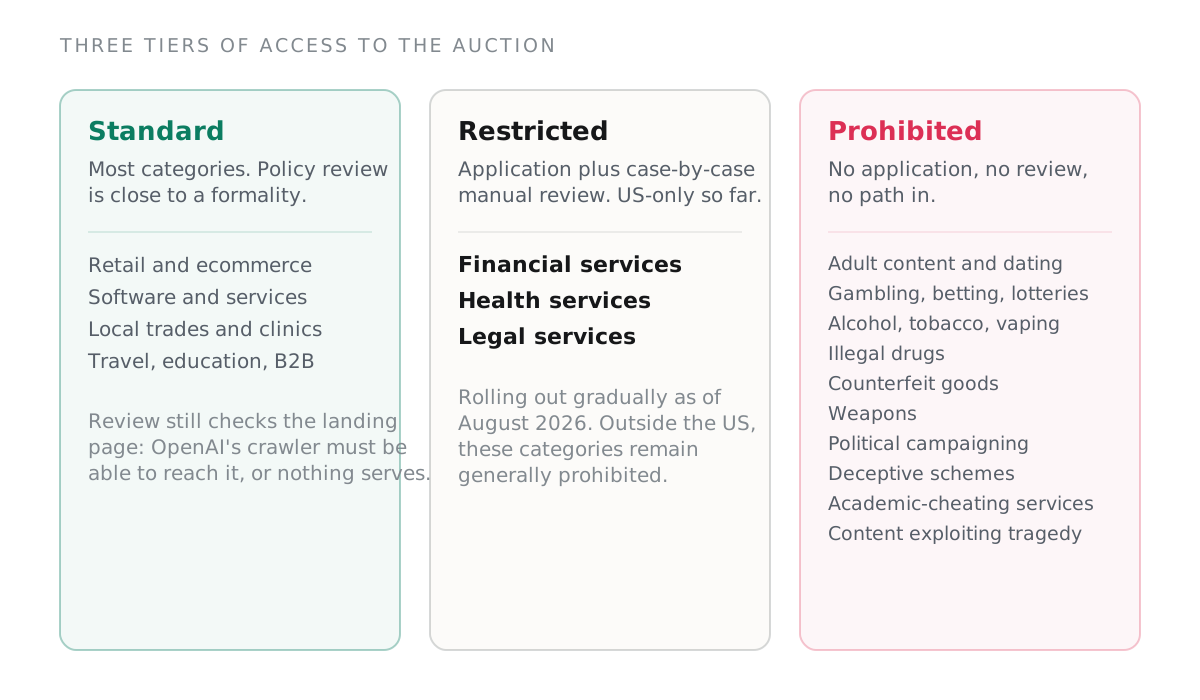
OpenAI's ad policy prohibits a set of categories outright. Not slow, not pending. Banned. As of August 2026, that list covers:
- Adult content and dating services
- Gambling, sports betting, and lotteries
- Alcohol and tobacco, including vaping and nicotine products
- Illegal drugs
- Counterfeit goods
- Weapons
- Political campaigning
- Deceptive schemes
- Academic-cheating services (essay mills, exam-answer services, and similar offerings)
- Content that exploits tragedy
Two more entries sit in the prohibited list for a less obvious reason. OpenAI won't approve an ad for one specific job listing or one specific property. You can't buy an ad for a single row house for sale or a single open req. Aggregator platforms (job boards, property marketplaces) are still eligible, as long as the ad and its landing page promote the platform generically rather than one listing on it. That distinction got a direct rewrite in the policy's most recent revision, dated August 10, 2026, which addressed housing and job listings specifically.
If you run a comparison or listings portal, read that rule before you build creative. Advertise the platform. Don't advertise the listing.
The restricted tier: finance, health, legal
Three categories sit outside both the clean list and the banned list. Financial services, health services, and legal services all require an advertiser-level application and case-by-case manual review. OpenAI has said this tier is rolling out gradually rather than opening all at once, and as of August 2026 it's US-only. Outside the US, ads in these categories remain generally prohibited under the current policy wording, European launch included.
Financial services covers credit cards, mortgages, investment products, and insurance, with some reporting naming auto loans, deposit accounts, and financial planning as additional eligible subcategories. Credit repair and debt settlement are carved out of this tier entirely. They're banned outright, same as gambling.
Health services come with a named list: health insurance, dental services, supplements, vision products, medical testing, and hospitals or urgent care. Outside that named list, the safer assumption is rejection, not approval. Unproven treatments and high-risk procedures are specifically called out as ineligible even within the health category.
Legal services are still effectively banned. OpenAI's own language is direct: ads for "legal advice, representation, or legal services offered to individuals or businesses are not permitted," including immigration, personal injury, legal claims, or document preparation. The one approved use is general legal education: content from a law school or legal-literacy publisher where no legal service is being sold.
The legal-services self-contradiction
Read the policy closely and it disagrees with itself on legal services. The summary section lists legal services alongside finance and health as a category where OpenAI "may approve ads from approved advertisers... on a case-by-case basis." The detailed section on legal services, quoted above, says advice and representation are simply not permitted, aside from the general-education exception.
Taken together, that reads as a category being staged for a future rollout while remaining closed today. That's a defensible position if the summary line describes direction rather than current state. But nothing on the page marks the distinction, and no changelog explains it. A law firm that reads the summary line and concludes it can advertise is reading the wrong clause.
The same placement-versus-eligibility confusion shows up in how people read the April 2026 update. That revision ended categorical ad-blocking near medical, legal, and financial conversations:
"Medical, legal, and financial advice contexts are no longer categorically blocked from ads by default."
That means an ad for a moving company can now appear while a user is mid-conversation about a legal question. It says nothing about who's allowed to buy the ad. Placement decides which conversations can carry an ad. Eligibility decides who's allowed to be the advertiser. The April change touched only the first.
How the policy has moved since February
The policy page is not a static document. By our count it has changed at least four times since the initial rollout:
- February 9, 2026: the policy accompanies the first ChatGPT ad test, US-only.
- April 2026: placement rules refined; medical, legal, and financial advice conversations stop being categorically blocked from carrying ads.
- May 2026: a new section explains OpenAI's enforcement standards and what happens when an ad misses the bar.
- July 2026: an advertiser-policies section is added; financial-services and health-services eligibility gets clarified.
- August 10, 2026: housing and job-listing rules are clarified, formalizing the single-listing ban and the aggregator exception described above.
So yes, the page changed again in August (three weeks before this was published), and the change landed directly on one of the rules advertisers most often get wrong. If your compliance read of this policy predates August 10, the listings rule under it is stale at minimum. Given that cadence, expect another revision before year-end rather than treating the current wording as settled.
No appeals, and a short list of ways to get flagged
Three layers of review sit between a submitted ad and a live one: advertiser eligibility, creative and landing-page content, and placement-context safety. The first two are mostly automated with human review on borderline cases. The third runs continuously; a placement that was safe for a conversation a minute ago may not be safe for where the conversation goes next.
Nowhere in OpenAI's public documentation is there a described appeals or escalation path. If your ad is rejected, your options are to read the reason given, if one is given, and resubmit. There's no published turnaround time and no route to a second opinion.
A handful of rejection triggers come up repeatedly in advertiser write-ups:
- Mimicking ChatGPT itself. The policy reserves the right to pull or force edits on any ad that imitates the appearance, functionality, or voice of ChatGPT or other OpenAI interfaces (anything a user could mistake for the product rather than a paid placement).
- Claiming the model's endorsement. Copy like "ChatGPT recommends this" reads as a policy violation on its own, and as a deceptive-advertising problem under FTC rules on top of it.
- Naming a competitor to disparage them. Comparative claims draw misrepresentation review. Framing your own product on its own terms clears faster.
- Unverified superlatives. "Best," "guaranteed," and pricing claims that can't be substantiated get flagged.
- Individual-level targeting language. Copy implying you can identify a specific visitor is treated as a privacy problem. The accepted framing operates at the company or aggregate level, not the person.
Advertisers also report inconsistent delivery independent of any single rejection: the same account, same category, clearing review in one cycle and stalling in the next with no explanation attached. If you're anywhere near the restricted tier, budget for that unpredictability as a fact of the platform, not a problem you solve once. For the mechanics of a clean submission, see our breakdown of account setup and creative specs. Most of the triggers above are avoidable in the brief, not fixable after a rejection.
The under-18 and sensitive-topic exclusions apply no matter who you are
Two exclusions sit outside the category system and apply to every advertiser, clean-tier or restricted-tier.
No ads go to under-18 accounts. OpenAI doesn't rely on self-reported age alone. It infers age from account signals (how long the account has existed, stated age, typical usage times, usage patterns over time, and the topics a person discusses) and withholds ads from any account it flags as belonging to a minor.
No ads appear near sensitive topics, regardless of who the advertiser is: personal health, mental health, and political conversations are excluded contexts. An approved dental-insurance advertiser can still fail to show against a conversation that drifts into health anxiety. Advertiser-level approval and placement-level exclusion are separate gates. Clearing one doesn't guarantee clearing the other.
For a moving company or an online course, this rarely bites; your buyers aren't discussing your category as a sensitive topic. For anyone in the restricted tier, it's a second filter stacked on the first: getting approved as an advertiser doesn't mean every relevant conversation is available inventory.
What the spend data says about who's actually getting through
Category rules are one thing. What advertisers actually spend is another. Sensor Tower's tracking shows financial-services ad spend on ChatGPT grew from 2% of total platform spend in April 2026 to 12% by July 2026 (the third-largest category on the platform by that measure).
That's a fast climb for a category that requires manual approval and, per OpenAI's own framing, is rolling out gradually. Read it two ways. First, the restricted tier isn't a formality. Real budget is clearing it, not just applying and waiting. Second, restricted doesn't mean small: finance grew its share of spend faster over three months than most of the unrestricted categories that launched with the platform in February.
We didn't find an equivalent public spend-share figure for health or legal. Treat the finance number as the one hard data point in this tier, not as a stand-in for how health or legal are pacing. Nobody outside OpenAI has published that breakdown.
What this means for your budget
If you're in moving and relocation, home energy, online education, travel, comparison portals, or e-commerce, none of this changes your process. You go through the same eligibility, creative, and placement review as the rest of the unrestricted majority. See how ChatGPT ads actually work for the mechanics, and use the rejection triggers above as a pre-submission checklist rather than something you find out about after the fact.
If you're in the restricted tier, plan differently:
- Budget review time in weeks, not days. Don't set a launch date that assumes approval lands by a specific point.
- Have licensing and registration documentation ready before you apply. The policy expects advertisers with professional credentials to hold and maintain them.
- Expect the sensitive-topic exclusion to sit on top of your advertiser approval, cutting your effective inventory below what category-level approval implies.
- Don't rely on a compliance read of the policy from before August 10, 2026. The listings clarification landed that day, and the revision cadence says another change is coming.
- Outside the US, don't plan around restricted-category access yet; the European launch didn't change that.
None of this is a reason to skip the restricted tier; real spend is clearing it, per the numbers above. It's a reason to put the friction into the plan instead of finding it after your first submission. Watching exactly this kind of category and policy movement over time, month to month rather than as a one-time read, is part of what our AI-visibility monitoring covers.
Questions we keep getting
Can a mortgage broker advertise on ChatGPT?
Mortgages fall inside the financial-services restricted tier. That means an advertiser-level application and manual, case-by-case review: not a ban, but not a self-serve signup either.
Can a law firm ever advertise on ChatGPT?
Not for its own legal services, as of August 2026. The only approved use is general legal education where no legal service is sold. A firm's "hire us" messaging isn't eligible under the current policy.
If my ad gets rejected, can I appeal?
There's no appeals or escalation process documented anywhere in OpenAI's public policy or help-center materials. Your recourse is reading the stated reason, if one is given, fixing it, and resubmitting.
Can I get around the single-listing rule by calling myself a platform?
No. OpenAI's rule targets what the ad and landing page actually promote, not how the account is labeled. A single job posting or single property listing is ineligible regardless of framing. The exception applies to platforms that host many listings and advertise themselves generically, not any one listing on the platform however it's described.
Does the restricted tier work the same way in Europe as in the US?
No. As of the August 24, 2026 European launch covering 31 markets, health and financial-services ads remain generally prohibited outside the US under the current policy wording. The manual-review pathway that exists for US advertisers in this tier hasn't been extended there. See our European rollout coverage for what has and hasn't launched.
Sources
- OpenAI: Ad policies (accessed August 2026)
- OpenAI Help Center: Ads in ChatGPT (accessed August 2026)
- Search Engine Journal: OpenAI Allows Some Health & Finance Ads In ChatGPT (August 2026)
- Abmatic AI: OpenAI Ads Policy 2026: What Gets Approved (and Rejected) (August 2026)
- BigGo Finance: ChatGPT Advertisers Triple to Over 800 as OpenAI Ramps Up Mobile Ad Volume (August 2026)
- Choice Marketing: ChatGPT Ads in 2026, Updated August: oCPC, Audiences, OAIQ Pixel (August 2026)
- Elite Solutions Digital: 8 Industries That Can't Advertise on ChatGPT (August 2026)
- Webris: How Your Law Firm Can Run Ads On ChatGPT (Despite OpenAI Restrictions) (July 2026)
- Ceaksan: Who Can Access ChatGPT Ads: Geographic Eligibility and Category Restrictions (August 2026)
- Adventure Media: ChatGPT Ads Compliance Guide: FTC Rules and Advertising Regulations in 2026 (April 2026)